
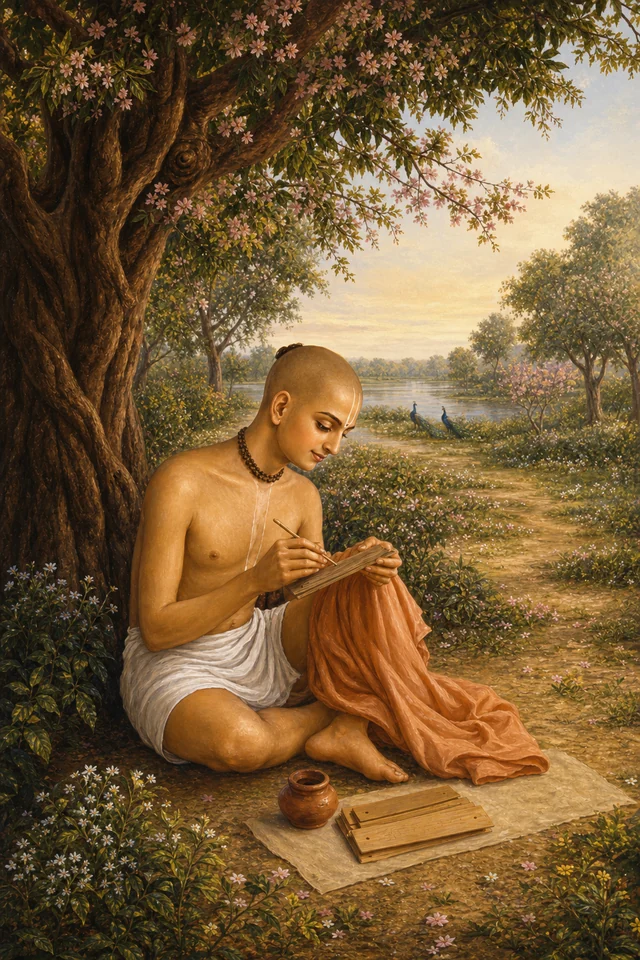
01
Bengal and Karnataka, c. 1489 CE
Origins
Śrīla Rūpa Goswāmī was born around 1489 CE, though some traditional sources give 1493. His father was the pious brāhmaṇa Kumāradeva. His family ancestry is traced to Karnataka in South India, through a line of learned Sārasvata brāhmaṇas of the Bhāradvāja gotra. Over time, the family line moved eastward and settled in Bengal, especially in the region connected with Jessore, Bakla Chandradvīpa, and Fatehabad, in present-day Bangladesh.
Before he became known to the world as Rūpa Goswāmī, he is remembered in some sources by the name Santoṣa, or Santoṣa Bhaṭṭa. His elder brother was Amara, later known as Sanātana Goswāmī. His younger brother was Vallabha, later known as Anupama. Anupama would become the father of Śrīla Jīva Goswāmī, who later emerged as the most systematic philosopher of the Gauḍīya Vaiṣṇava tradition.
The three brothers were highly educated. They were trained in Sanskrit learning, śāstra, logic, and the literary culture of the time. Because Bengal was then ruled by the Sultanate, they also became familiar with Persian and Arabic administrative culture. This combination of scriptural learning, literary refinement, and political intelligence would later shape Rūpa Goswāmī's extraordinary ability to write theology with poetic force and precision.
Eventually, Rūpa and Sanātana were drawn into the service of Sulṭān Alāuddīn Ḥusayn Shāh of Bengal. Sanātana held the title Sākara Mallika and served in a senior ministerial role. Rūpa held the title Dabīr Khāṣ, a high confidential secretary connected with the Sultan's administration. The title should not be read too narrowly as "finance minister," though his position clearly involved elite government responsibility, wealth, and influence.
The brothers lived in aristocratic comfort at Ramakeli, in Gauḍa. They had position, learning, property, and social power. Yet inwardly they felt trapped. Their hearts were already moving toward Kṛṣṇa and toward the devotional current that Śrī Caitanya Mahāprabhu was revealing.
02
Ramakeli: The First Meeting
Around 1514, though some accounts place the date slightly earlier, Śrī Caitanya Mahāprabhu came to Ramakeli. The Caitanya-caritāmṛta preserves the inner reason for this journey. Mahāprabhu told the two brothers that He had no other real business in Bengal; He had come to see them.
That statement reveals how deeply Mahāprabhu already regarded them. Outwardly, they were ministers in a Muslim court. Inwardly, they were His own eternal servants, waiting for the moment when their public lives and inner identity would finally meet.
The brothers approached Him with deep humility. They had already been corresponding with Him, praying for deliverance from their situation. They felt themselves bound to worldly service while their hearts belonged elsewhere. Mahāprabhu reassured them that Kṛṣṇa would soon free them.
In Gauḍīya memory, this meeting marks the beginning of their open transformation. Dabīr Khāṣ would become Śrī Rūpa Goswāmī. Sākara Mallika would become Śrī Sanātana Goswāmī. Vallabha would later become known as Anupama. Their new names were not merely religious titles. They marked a change of life, identity, purpose, and destiny.
Not long after this meeting, renunciation awakened powerfully in both brothers. Rūpa left government service first. He gathered the wealth he had accumulated, loaded it onto boats, and returned with Anupama to the family's home region in Bengal. There he divided his wealth with striking deliberation. Fifty percent he gave to brāhmaṇas and Vaiṣṇavas. Twenty-five percent he gave for the maintenance of his relatives and extended family. The remaining portion he kept for emergencies.
Out of that reserved wealth, he deposited ten thousand gold coins for Sanātana, knowing his elder brother might need help escaping from the Sultan's service. That foresight became essential. When Sanātana later refused to continue his government duties, he was imprisoned. He used those funds to bribe the jailer and escape, eventually making his way to Vārāṇasī, where he met Mahāprabhu again.
Rūpa's renunciation was therefore not impulsive. It was thoughtful, responsible, and practical. He did not simply abandon everything in a dramatic gesture. He arranged his obligations, protected his family, supported Vaiṣṇavas, and left a path open for his brother's freedom.
03
Reunion at Prayāga
After settling his affairs, Rūpa did not wait passively for news. He sent messengers to Jagannātha Purī to learn where Mahāprabhu could be found. They returned with word that Mahāprabhu had left Purī, traveled to Vṛndāvana, and was now on His way back.
Rūpa immediately wrote to Sanātana, who was still entangled in the Sultan's service, urging him to free himself as soon as possible. Then Rūpa set out with Anupama to find Mahāprabhu.
They met Him at Prayāga, modern Allahabad, at the confluence of the Gaṅgā, Yamunā, and Sarasvatī. Mahāprabhu was then performing saṅkīrtana at the Bindu-Mādhava temple. The crowds were immense. The Caitanya-caritāmṛta describes the entire area as flooded, not by river water, but by waves of ecstatic love.
Because of the crowd, Rūpa and Anupama could not approach Him publicly. Mahāprabhu was staying nearby at the home of a South Indian brāhmaṇa, and there the brothers came before Him in a quieter setting. Holding straw between their teeth, a traditional sign of extreme humility, they fell flat like rods before Him. Mahāprabhu received them with affection. He embraced them and placed His feet upon their heads.
Sanātana was not present at this meeting. His own extended instruction from Mahāprabhu came later in Vārāṇasī, at the home of Candraśekhara. There Mahāprabhu taught him about the nature of the living being, the process of bhakti, the forms and expansions of Kṛṣṇa, and the structure of devotional practice. Sanātana would later become the great systematizer of Gauḍīya theology and practice, especially through works such as Bṛhad-bhāgavatāmṛta and his contribution to Hari-bhakti-vilāsa.
Rūpa's instruction was different. At Prayāga, over ten days, Mahāprabhu poured into him the essence of bhakti-rasa, the theology of devotional emotion. These teachings would later become the seed of Rūpa's great work, Bhakti-rasāmṛta-sindhu.
Mahāprabhu gave Rūpa a clear mission: to go to Vṛndāvana, uncover the forgotten places of Kṛṣṇa's pastimes, establish Deity worship, write scriptures explaining bhakti, and spread devotional service for the benefit of the world. This was not a vague blessing. It was a commission. Rūpa was being sent to give language, structure, and literary form to Mahāprabhu's inner gift.
04
The Journey to Purī and the Palm-Leaf Verse
Before settling permanently in Vṛndāvana, Rūpa eventually traveled toward Jagannātha Purī, where Mahāprabhu lived with His intimate associates. Anupama did not complete the journey to Nīlācala. After the brothers returned to Gauḍa, he attained gaṅgā-prāpti, "the shelter of the Ganges," and passed from this world. Delayed by his brother's departure, Rūpa later continued alone toward Jagannātha Purī. Anupama left behind his young son, Jīva, who would later come to Vṛndāvana and become Rūpa's disciple.
Rūpa continued onward to Purī alone. There he was received not only by Mahāprabhu, but also by Svarūpa Dāmodara Goswāmī, Rāmānanda Rāya, and the Lord's intimate circle. These were not casual devotees. They were the ones who understood Mahāprabhu's deepest moods. Among them, Rūpa was recognized as someone uniquely empowered to understand and express the Lord's heart.
During Rūpa's stay in Purī, one of the most important moments in his life took place. Mahāprabhu would sometimes recite a verse during the Ratha-yātrā festival that appeared, externally, to be a romantic verse of worldly longing. Almost no one understood why it moved Him so deeply. Svarūpa Dāmodara knew the inner meaning: Mahāprabhu was tasting Śrīmatī Rādhārāṇī's mood at Kurukṣetra, longing to bring Kṛṣṇa back to Vṛndāvana.
Rūpa understood this hidden meaning. One day, while Mahāprabhu was away, Rūpa composed a Sanskrit verse and wrote it on a palm leaf:
priyaḥ so 'yaṁ kṛṣṇaḥ saha-cari kuru-kṣetra-militas
tathāhaṁ sā rādhā tad idam ubhayoḥ saṅgama-sukham
tathāpy antaḥ-khelan-madhura-muralī-pañcama-juṣe
mano me kālindī-pulina-vipināya spṛhayati
Rūpa's verse expresses the experience in this way: Rādhā has met Kṛṣṇa again at Kurukṣetra. He is the same Kṛṣṇa, and She is the same Rādhā. Their meeting is joyful, yet Her heart longs for the banks of the Yamunā, for the forest of Vṛndāvana, and for the intimate sound of His flute.
Rūpa placed the palm leaf in the thatched roof and went to bathe in the sea. Mahāprabhu came, saw the leaf, read the verse, and became overwhelmed. When Rūpa returned, Mahāprabhu asked him how he had understood His heart. The Lord embraced him and later showed the verse to Svarūpa Dāmodara. Svarūpa concluded that Rūpa could only have understood this because Mahāprabhu had personally bestowed His mercy upon him.
This moment defines Rūpa Goswāmī's place in the tradition. He was not merely a scholar writing about devotion from the outside. He was the one who received Mahāprabhu's inner mood and gave it literary, theological, and devotional form.
The palm-leaf incident was not isolated. On another occasion, Mahāprabhu saw Rūpa's manuscript and praised his handwriting as being like rows of pearls. When Rūpa's writings were read aloud, the devotees were astonished. Rāmānanda Rāya praised his poetry as a continuous shower of nectar. After the Dolā-yātrā festival, Mahāprabhu instructed Rūpa to return to Vṛndāvana and take up the mission fully.
05
Arrival in an Empty Forest
Rūpa arrived in Vṛndāvana around 1516 or 1517, soon after Mahāprabhu's own visit there. Sanātana also came, and the two brothers were reunited after a long separation.
The Vṛndāvana they entered was not the temple town known today. It was largely forest, with many of Kṛṣṇa's pastime places forgotten, hidden, or preserved only in scattered local memory. There were no great temple complexes. There were no organized pilgrimage routes. Much of the sacred geography had to be rediscovered.
Rūpa and Sanātana lived with almost no possessions. They wore simple cloth, slept under trees, moved from place to place, and survived by begging. Later tradition remembers them resting in thorny places, forest groves, and even abandoned burrows. Their life was not romantic poverty. It was intense, disciplined renunciation in service of a specific mission.
They walked through Vraja, listened to local memories, studied scripture, identified sacred places, established worship, and began the literary work that would define Gauḍīya Vaiṣṇavism for generations.
06
The Discovery of Govindajī
Among Rūpa Goswāmī's most celebrated services was the recovery of the Govinda Deity. Tradition holds that long before Rūpa's time, Kṛṣṇa's great-grandson Vajranābha had established several Deities in Vraja, including Govindajī. Over time, their locations were lost.
Rūpa searched for Govinda with great longing. He especially sought the Yoga-pīṭha, the sacred center of Kṛṣṇa's Vṛndāvana pastimes. For months he searched without success.
Exhausted and disheartened, Rūpa sat by the Yamunā and began chanting Mahāprabhu's name in tears. Then a young Vrajavāsī boy appeared before him and asked why he was so distressed. When Rūpa explained his longing to find Govindajī, the boy told him of a place called Goma-ṭilā, where a cow came each afternoon and willingly let down her milk upon the earth. There, he explained, Śrī Govinda was hidden beneath the ground. The boy then led Rūpa to the spot and disappeared.
Rūpa understood that Kṛṣṇa Himself had come in disguise. Gazing into the milk-soaked place, he was overcome with ecstasy. When he regained external consciousness, he called local Vrajavāsīs to help excavate the site, and there they uncovered the Deity of Govinda.
At first, the worship was simple. Later, Govindajī became one of the principal Deities of the Gauḍīya Vaiṣṇava tradition. Decades after Rūpa's passing, Rāja Mān Siṅgh of Amber, a general under Akbar, funded the construction of a magnificent red-sandstone temple for Govindajī. The temple was built around 1590 and became one of the architectural wonders of North India.
During Aurangzeb's campaign against temples in Vṛndāvana, the Govindajī temple was damaged, and the original Deity was moved to Jaipur for protection. Govindajī is still worshiped there today. In Vṛndāvana, a representative form, a pratibhū-mūrti, continues to receive worship at the original sacred site.
Continue into Vraja Darśana
Govindajī is one of the core Vṛndāvana temples that shaped the devotional geography restored by the Goswāmīs.
Explore Vraja Maṇḍala Darśana07
Writing at Rādhā-Dāmodara
Rūpa Goswāmī's literary contribution is enormous. Later tradition counts many works in his name, and remembers him as one of the greatest Sanskrit devotional writers in Indian religious history.
He lived simply, wearing only a kaupīna and a patched cloth, yet his writings were refined, exact, and deeply poetic. He did not write merely to preserve information. He wrote to give the Gauḍīya tradition its language of devotion.
Bhakti-rasāmṛta-sindhu
His masterwork on pure devotion, sādhana, bhāva, prema, and the devotional rasas.
Ujjvala-nīlamaṇi
The companion text that expands the Gauḍīya understanding of mādhurya-rasa.
Upadeśāmṛta
A concise doorway into devotional conduct, association, humility, and Rādhā-kuṇḍa.
Bhakti-rasāmṛta-sindhu, "The Ocean of the Nectar of Devotion," presents bhakti as a complete science of devotional life. It defines pure devotion, explains sādhana-bhakti, bhāva-bhakti, and prema-bhakti, and then analyzes the devotional rasas, or relationships with Kṛṣṇa. The work applies the language of Sanskrit aesthetic theory to spiritual emotion, but it does so in a distinctly Gauḍīya way. This is the text that A.C. Bhaktivedanta Swami Prabhupāda later presented in English summary form as The Nectar of Devotion.
Ujjvala-nīlamaṇi focuses specifically on mādhurya-rasa, the conjugal mood of devotion, and expands what Bhakti-rasāmṛta-sindhu treats more briefly. It is one of the most important texts for understanding the Gauḍīya conception of Rādhā-Kṛṣṇa's intimate Vṛndāvana pastimes.
Vidagdha-mādhava and Lalitā-mādhava are two dramas that were originally conceived as one work. Tradition explains that Rūpa received instruction to divide them into two. Vidagdha-mādhava presents Kṛṣṇa's Vṛndāvana pastimes, while Lalitā-mādhava deals with later pastimes connected with Mathurā and Dvārakā. Vedabase notes dates of 1532 for Vidagdha-mādhava and 1537 for Lalitā-mādhava.
Upadeśāmṛta, known in English as The Nectar of Instruction, is one of Rūpa's most practical texts. It teaches control of speech, mind, anger, tongue, belly, and genitals; the dangers that weaken devotion; the qualities that nourish bhakti; the importance of association; and the exalted position of Rādhā-kuṇḍa. For many devotees, this is the doorway into Rūpa Goswāmī's teachings.
Other works include Dāna-keli-kaumudī, Stava-mālā, Padyāvalī, Haṁsa-dūta, Uddhava-sandeśa, Nātaka-candrikā, Mathurā-māhātmya, Rādhā-kṛṣṇa-gaṇoddeśa-dīpikā, and many hymns, prayers, dramas, and poetic compositions.
Through these works, Rūpa did something rare. He made the most intimate devotional emotions intelligible without making them ordinary. He gave structure without drying the subject. He gave poetry without losing discipline. He showed that love of Kṛṣṇa is not sentiment without form, but a spiritual reality with stages, qualities, relationships, and a final goal.
08
The Grammar of Divine Love
Rūpa Goswāmī's central contribution was not only that he wrote many books. His deeper contribution was that he gave Gauḍīya Vaiṣṇavism its grammar of divine love.
Mahāprabhu revealed the mood of devotion. Rūpa explained how that devotion could be understood, practiced, protected, and transmitted.
He taught that pure bhakti is not motivated by karma, jñāna, social prestige, liberation, or personal gain. Pure devotion is service to Kṛṣṇa done favorably, without selfish obstruction.
He described how devotion begins with faith, grows through association and practice, becomes purified through the removal of unwanted habits, deepens into steadiness and taste, matures into attachment, and eventually blossoms into bhāva and prema.
He also explained that devotion is relational. The soul does not merely dissolve into a spiritual abstraction. The soul serves Kṛṣṇa in a living relationship. These relationships include śānta, dāsya, sakhya, vātsalya, and mādhurya. Among these, Gauḍīya Vaiṣṇavism gives special honor to the love of the Vraja-gopīs, and above all to Śrīmatī Rādhārāṇī's love.
This is why Rūpa is so central. He gave shape to the path of rāgānugā-bhakti, the path of following the spontaneous devotion of Kṛṣṇa's eternal associates in Vraja. He did not present this as emotional imitation. He presented it as a sacred path requiring humility, purification, guidance, and deep absorption in service.
Companion Reading: Rādhā-kuṇḍa
Rūpa's Upadeśāmṛta reaches its devotional summit in the praise of Rādhā-kuṇḍa, the most intimate place of Rādhā and Kṛṣṇa's service.
Read the Rādhā-kuṇḍa Guide09
Family, Discipleship, and Jīva Goswāmī
After Rūpa and Sanātana settled in Vṛndāvana, their nephew Jīva Goswāmī eventually joined them. Jīva was the son of Anupama, who had passed away earlier. Before coming to Vṛndāvana, Jīva had gone through Navadvīpa and Vārāṇasī, receiving education and deepening his devotion.
In Vṛndāvana, Jīva took shelter of Rūpa and became his disciple. He would later become the tradition's greatest systematic philosopher, especially through his Ṣaṭ-sandarbhas.
The bond between Rūpa and Jīva is preserved most visibly at the Rādhā-Dāmodara temple. Temple tradition, citing Sādhana-dīpikā, holds that Śrī Dāmodara was manifested through Rūpa Goswāmī's own hands and then given by him to Jīva Goswāmī for worship. Worship of Śrī Śrī Rādhā-Dāmodara is traditionally connected with the year 1542. The temple as a built institution developed around that sacred service, and Rādhā-Dāmodara remains one of the most important Gauḍīya temples in Vṛndāvana.
The Rādhā-Dāmodara compound preserves several of the tradition's most important sacred memorials: Rūpa Goswāmī's bhajana-kuṭīra and samādhi, Jīva Goswāmī's samādhi, and the samādhi of Kṛṣṇadāsa Kavirāja Goswāmī. For Gauḍīya Vaiṣṇavas, Rādhā-Dāmodara is not simply an old temple. It is one of the intellectual and devotional centers from which the tradition took shape.
Jīva was not the only figure shaped by Rūpa and Sanātana. After Mahāprabhu's disappearance, Raghunātha Dāsa Goswāmī came to Vṛndāvana in unbearable separation. He had renounced immense wealth to serve Mahāprabhu in Purī. After the Lord's departure from this world, he intended to end his life at Govardhana rather than live without Him.
Rūpa and Sanātana received him and redirected his grief into service. They gave him residence at Rādhā-kuṇḍa and asked him to speak daily about Mahāprabhu's pastimes in Purī. Raghunātha Dāsa went on to become the embodiment of renunciation and one of the deepest teachers of internal devotion in the tradition.
The relationship between Rūpa and Raghunātha became so important that later Gauḍīya teachers often speak of aspiring for the dust of the feet of "Śrī Rūpa and Raghunātha." This is not merely a poetic pairing. It represents the union of Rūpa's theology of divine love and Raghunātha's life of intense internal absorption.
10
Rūpa Among the Six Goswāmīs
The Six Goswāmīs of Vṛndāvana are usually named together: Rūpa Goswāmī, Sanātana Goswāmī, Jīva Goswāmī, Raghunātha Dāsa Goswāmī, Gopāla Bhaṭṭa Goswāmī, and Raghunātha Bhaṭṭa Goswāmī.
Each had a distinct contribution. Sanātana, Rūpa's elder brother, was the senior guide in many practical and theological matters. He wrote foundational works and helped establish the structure of Vaiṣṇava practice. Jīva, Rūpa's nephew and disciple, systematized Gauḍīya philosophy with unmatched depth. Raghunātha Dāsa embodied renunciation and internal service at Rādhā-kuṇḍa.
Gopāla Bhaṭṭa, from South India, contributed to the tradition of Deity worship and Vaiṣṇava practice, and is connected with the appearance of Śrī Rādhā-ramaṇa. Raghunātha Bhaṭṭa was known for his recitation of Śrīmad-Bhāgavatam and his devotional purity.
Among them, Rūpa became the principal literary and theological voice of Mahāprabhu's inner gift. This is why Gauḍīya Vaiṣṇavas call themselves Rūpānugas, followers of Rūpa.
To be Rūpānuga means more than respecting Rūpa Goswāmī as a historical saint. It means following the devotional mood he received from Mahāprabhu and expressed in his writings. It means approaching Kṛṣṇa through the path of service to Vraja, with special reverence for Śrīmatī Rādhārāṇī's love and the service mood of Her attendants.
Another Goswāmī Life
Gopāla Bhaṭṭa Goswāmī's life shows another side of the Vṛndāvana mission: worship, ritual structure, and the appearance of Śrī Rādhā-ramaṇa.
Read Gopāla Bhaṭṭa Goswāmī11
Character, Mood, and Eternal Identity
Rūpa Goswāmī's life shows an unusual combination of qualities. He was learned, but not proud. He was poetic, but not vague. He was renounced, but not careless. He was systematic, but not dry.
He could move from court administration to forest renunciation, from political responsibility to ecstatic poetry, from precise theological definition to the most delicate moods of Rādhā and Kṛṣṇa.
His humility was not decorative. When he approached Mahāprabhu, he did so with straw between his teeth. When his writings were praised, he remained shy. When he received empowerment, he did not use it to build a personal following around himself. He used it to serve Mahāprabhu's mission.
His goal was not to become famous as an author. His goal was to reveal the path of loving service to Rādhā-Govinda.
In the confidential theology of the Gauḍīya tradition, Rūpa Goswāmī is understood to be Rūpa Mañjarī in the eternal pastimes of Rādhā and Kṛṣṇa. Rūpa Mañjarī is described as the foremost of Śrīmatī Rādhārāṇī's intimate maidservants, serving under Lalitā-sakhī. This identity explains why Rūpa Goswāmī's writings are so centered on the service of Rādhā and Kṛṣṇa in Vṛndāvana. He was not approaching these realities from outside. He was revealing, in this world, the service mood that belongs eternally to Vraja.
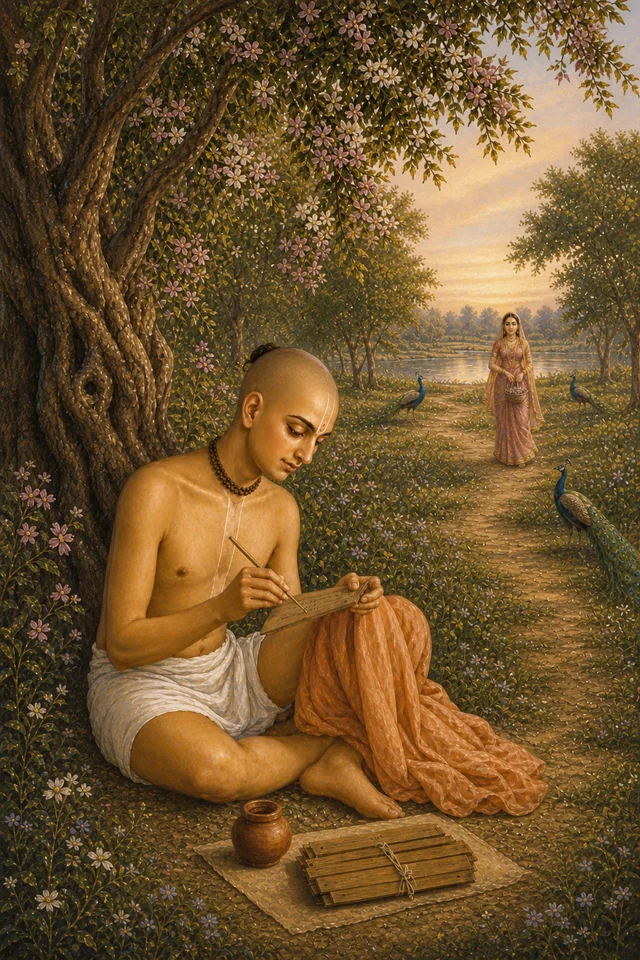
This artwork follows the tradition's visual language: Rūpa Goswāmī writes in the foreground, while the distant mañjarī figure points quietly to his eternal identity as Rūpa Mañjarī. The symbolism is theological, connecting his service and writings in this world with his eternal service in Vraja.
Later teachers such as Narottama Dāsa Ṭhākura, Bhaktivinoda Ṭhākura, and Bhaktisiddhānta Sarasvatī Ṭhākura repeatedly held up Rūpa as the standard for Gauḍīya aspiration. To follow Mahāprabhu deeply is to come under the guidance of Rūpa. To enter the service mood of Vraja is to seek shelter in the line of Rūpa Mañjarī.
This is why the word Rūpānuga carries such weight. It names the heart of the tradition.
12
Passing, Samādhi, and Legacy
Rūpa Goswāmī passed from this world around 1564, though some sources preserve other dates. He lived into old age, having spent the last decades of his life in Vṛndāvana, absorbed in writing, bhajana, Deity service, and the fulfillment of Mahāprabhu's order.
His samādhi-mandira stands today in the courtyard of the Rādhā-Dāmodara temple. Nearby are his bhajana-kuṭīra, the samādhi of Jīva Goswāmī, and the samādhi of Kṛṣṇadāsa Kavirāja Goswāmī, the author of Caitanya-caritāmṛta.
For devotees, this place is not simply memorial. It is a living center of remembrance. Rūpa's body rests there, but his voice continues through his books, his Deities, his followers, and the path of devotion he shaped.
Rūpa Goswāmī's legacy cannot be measured only by the number of books he wrote or temples connected with him. His real legacy is that he taught the world how to understand love of God as the highest reality.
He showed that bhakti is not a vague religious feeling. It is a complete path. He showed that Kṛṣṇa is not merely the Supreme Lord in majesty, but the beloved of Vraja. He showed that Śrīmatī Rādhārāṇī's love is the highest expression of devotion. He showed that Mahāprabhu's gift was not a new sectarian enthusiasm, but the deepest current of the eternal Vraja mood brought into the world through nāma-saṅkīrtana.
He showed that the highest theology must become service.
Two of his remembered verses capture the breadth of his life. In the beginning of Bhakti-rasāmṛta-sindhu, he describes pure devotees as swimmers in the ocean of devotion, uninterested in the shallow streams of liberation. And in Vidagdha-mādhava, reflecting on the holy name, he writes in longing that one tongue and two ears are not enough. He wants millions of tongues and millions of ears simply to go on tasting and hearing the name of Kṛṣṇa.
That is Rūpa Goswāmī: the theologian of rasa, the servant of Mahāprabhu's heart, the discoverer of Govindajī, the guide of Vṛndāvana, the teacher of the Rūpānugas, and the one who gave divine love a language without reducing its mystery.
Image Credits and References
Hero image: original Prema Dhvani generated devotional artwork depicting Rūpa Goswāmī writing in Vṛndāvana. Chapter 11 image: original Prema Dhvani generated devotional artwork using the distant mañjarī figure to symbolize Rūpa Mañjarī.
Primary references checked for the article include Caitanya-caritāmṛta Madhya 1.212, Caitanya-caritāmṛta Madhya 19, Caitanya-caritāmṛta Antya 1, Bhakti-ratnākara Chapter Two, the Śrī Śrī Rādhā-Dāmodar Mandir history, and the Rādhā-Dāmodara temple tradition citing Sādhana-dīpikā.