
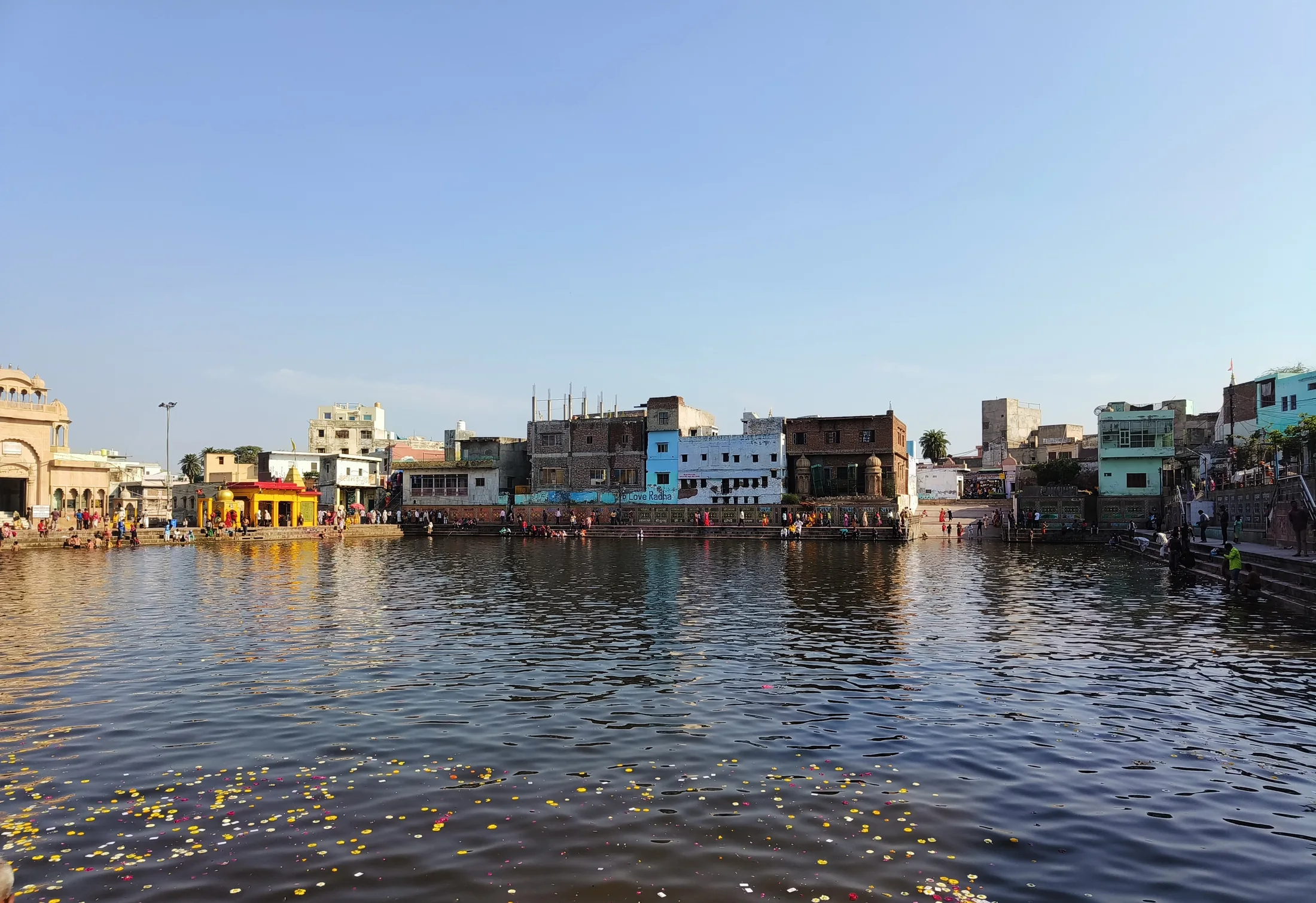
01
Why Radha Kund Stands Above Every Other Holy Place
In the geography of Vraja, every tīrtha carries meaning, but the Gauḍīya ācāryas place one small pair of ponds above all of it, above Vṛndāvana, above Govardhana, above Nandagrāma and Varṣāṇā. That place is Rādhā-kuṇḍa.
This is not a devotional exaggeration to be softened for outsiders. It is a stated theological position, argued verse by verse, most famously by Śrīla Rūpa Gosvāmī in three closing ślokas of his Upadeśāmṛta (verses 9–11). Rūpa Gosvāmī builds an ascending hierarchy: Vaikuṇṭha is surpassed by Mathurā, because the Lord appeared there; Mathurā is surpassed by Vṛndāvana, because of the rāsa dance; Vṛndāvana is surpassed by Govardhana, because Kṛṣṇa's most intimate pastimes of the hands (feeding, resting, sporting) occurred there; and Govardhana itself is surpassed by Rādhā-kuṇḍa, because it is flooded with the nectar of Kṛṣṇa's prema for the gopī-pati, the Lord of the gopīs. The final verse states plainly that a single bath in this kuṇḍa reveals a love that even Kṛṣṇa's most cherished associates cannot easily obtain, a love ordinarily inaccessible to bhakti-bhājām, those already engaged in devotional service. That is the claim this place makes for itself, and it is the reason a serious pilgrim does not walk up to Rādhā-kuṇḍa the way one walks up to any other kuṇḍa in Braj.
To understand why, you have to understand what the water actually is in Gauḍīya theology, not a monument to an event, but a manifestation of Śrīmatī Rādhārāṇī's own body of love. The commentators are explicit on this point: Rādhā-kuṇḍa is non-different from Rādhārāṇī Herself. Bathing there is not visiting a site connected to Her. It is entering Her.
02
The Appearance Pastime: Ariṣṭāsura and the Two Kuṇḍas
The bare narrative frame, Kṛṣṇa slaying the bull-demon, the gopīs' rebuke, the digging of the two kuṇḍas, comes from the Ādi Varāha Purāṇa (in the Govardhana-parikramā section), tied chronologically to the demon-slaying recorded in Śrīmad-Bhāgavatam 10.36. The fuller, dialogue-rich telling that most devotees actually know today, Rādhā's specific refusal of Kṛṣṇa's water, the gopīs' chain of pots from Mānasī-gaṅgā, and Kṛṣṇa sending the river-deities to beg Rādhā's permission, is the elaboration of Śrīla Viśvanātha Cakravartī Ṭhākura, given in his Sārārtha-darśinī commentary tradition and in verses collected as a "conversation between Rādhā and Kṛṣṇa." It is this fuller version the pastime is followed here.
Kaṁsa, having failed repeatedly to kill Kṛṣṇa, sent Ariṣṭāsura, a demon who assumed the form of a monstrous bull, into Vraja to destroy Him. Kṛṣṇa met the bull-demon in battle north of Mānasī-gaṅgā and killed him, breaking one of his horns and casting his body aside.
Immediately after, Kṛṣṇa approached Rādhārāṇī and the sakhīs, eager as always to be near Her. But Rādhā and the gopīs, in a mood that is remembered as praṇaya-māna, the sweet, teasing displeasure that only intimate love permits, refused Him. They told Him He had incurred the sin of go-vadha, the killing of a bull, since the cow and bull are treated in dharmic literature as sacred, and that He was therefore impure and unfit to touch until He atoned by bathing in all the holy waters of the universe.
This is worth pausing on, because it is easy to read past as a minor plot device. Theologically, the gopīs' accusation is not really about ritual purity, Kṛṣṇa, as Bhagavān, cannot be contaminated by anything. It is a pretext, a vyāja, that Rādhārāṇī's sakhīs construct so that the pastime of the kuṇḍas' creation can unfold, and so that a particular quality of Rādhā's love, Her capacity to make even the Supreme Lord submit to Her will and desire Her forgiveness, can be displayed and later left behind for the devotee to enter.
To satisfy Her, Kṛṣṇa struck His heel into the earth and summoned every sacred river and pilgrimage water in creation to fill the depression. Kṛṣṇa bathed in that newly manifested pond and declared Himself purified; it became known as Śyāma-kuṇḍa, the kuṇḍa of Śyāma. Then, in the playful logic of the same exchange, Kṛṣṇa turned the accusation back toward the gopīs: if He had now become pure by bathing in Śyāma-kuṇḍa, then they too had become impure, because they had sided with Ariṣṭāsura, even though he had appeared in the form of a bull. This reversal is what moves Rādhārāṇī and Her companions to answer Kṛṣṇa not with argument, but by creating a kuṇḍa of their own.
Rādhārāṇī then turned to Her sakhīs and answered Kṛṣṇa's accusation with a decision: if they were impure, they would become pure by making a kuṇḍa even better than His. Leading the gopīs a short distance west of Śyāma-kuṇḍa, She came upon a shallow ditch made by Ariṣṭāsura's hooves and chose that place for Her own pond. At Her instruction, the gopīs began digging with astonishing speed, some accounts say by breaking their own bangles and using the rims to scrape the earth, lifting and discarding clumps of soft clay until, within about an hour, a large hollow had appeared. Kṛṣṇa watched in amazement. When they came out of the newly dug hollow, He generously offered to fill it with the sacred water from His own kuṇḍa.
Rādhā refused outright. Her reasoning, preserved in a verse attributed to Viśvanātha Cakravartī Ṭhākura, is pointed rather than polite: "No, no, no, no! This is impossible, since the water of Your pond is contaminated by Your terrible sin of killing a cow." The very water Kṛṣṇa had just used to declare Himself pure, Rādhā turns around and names as unfit for Her own kuṇḍa, a piece of theological wit as much as a display of praṇaya-māna, since it is Rādhā's prerogative alone to judge Kṛṣṇa's purity.
But a dug hollow is not a kuṇḍa; it held no water. Rather than accept Kṛṣṇa's water, Rādhā declared She would have Her own gopī companions bring pure water from Mānasī-gaṅgā, Kṛṣṇa's earlier, mind-manifested Ganges, nearly five kilometers away at Govardhana. The gopīs organized themselves into a long human chain stretching from Mānasī-gaṅgā to the new hollow, passing pot after pot of water hand to hand toward Rādhā-kuṇḍa.
Kṛṣṇa, watching this unfold, could not bear to see Rādhārāṇī and Her companions laboring and perspiring for His sake. So He turned to the very river-deities who had just filled His own Śyāma-kuṇḍa, the personified forms of the Gaṅgā, Yamunā, Sarasvatī, and the other sacred waters, and instructed them to go to Rādhā-kuṇḍa themselves, to bow before Rādhārāṇī, and to beg Her permission to enter Her pond directly. The rivers obeyed: they approached Her in their personified forms, folded their hands, and pleaded to be allowed to complete Her kuṇḍa out of their own devotion to Her, sparing the gopīs their exhausting labor. Moved by their sincerity, Rādhā granted it, and the sacred waters flowed in, completing Rādhā-kuṇḍa not through the gopīs' own straining effort in the end, but through the same holy tīrthas surrendering to Rādhā a second time, first to Kṛṣṇa and then, at His own request, to Her.
After the sacred waters entered and filled Her pond, Kṛṣṇa glorified Rādhā-kuṇḍa before Rādhārāṇī. He declared that Her kuṇḍa would become even more famous than His own, and that He would always come there to bathe and enjoy water pastimes, because Rādhā-kuṇḍa was as dear to Him as Rādhā Herself. Rādhārāṇī, deeply pleased, then glorified Śyāma-kuṇḍa in return, promising that She and Her sakhīs would also bathe in Kṛṣṇa's pond, even if He were to kill hundreds of Ariṣṭāsuras there. In this mutual praise, the two kuṇḍas are revealed not as rival ponds, but as the paired bathing places of Rādhā and Kṛṣṇa's love. Raghunātha Dāsa Gosvāmī's Rādhā-kuṇḍāṣṭaka commemorates this directly: Kṛṣṇa Himself, he writes, bathes here daily in order to draw Rādhā's merciful glance.
That night, according to the tradition preserved by later Gauḍīya writers (recorded, for instance, in the Harmonist tradition of Rādhā-kuṇḍa-māhātmya teachings), Kṛṣṇa met Rādhā and the sakhīs again at this very spot for unrestricted, unobstructed loving pastimes, a freedom of intimacy the ācāryas say is not available even at Vṛndāvana's rāsa-sthalī or at Govardhana's keli-kuṇḍa pastimes, because at those places the pastimes must still observe a degree of concealment. At Rādhā-kuṇḍa, the tradition holds, the two Kuṇḍas themselves form a hidden, doubly-sheltered enclosure where the aṣṭakālīya-līlā, Rādhā and Kṛṣṇa's eightfold daily pastimes, are performed without any obstruction at all. This is the theological basis for calling Rādhā-kuṇḍa the topmost site of bhajana in the whole of Vraja-maṇḍala.
Krishna kills the bull-demon and the gopis raise the charge of ritual impurity.
Krishna summons the sacred waters into His own newly opened pond.
Radha and the sakhis dig their own kunda, and the tirthas enter with Her permission.
03
Two Appearance Days, and Why Both Matter
Pilgrims are often confused to find two separate dates celebrated as "Rādhā-kuṇḍa's appearance." Both are legitimate, and they mark two different events.
Caitra Pūrṇimā, the actual manifestation. Śrīla Jīva Gosvāmī, in his commentary on Bhāgavatam 10.45.3 and again in Gopāla-campū (1.31.8), identifies the full moon of the month of Caitra (March–April), specifically when it coincides with the Citrā nakṣatra, as the precise moment Kṛṣṇa manifested Śyāma-kuṇḍa and Rādhā-kuṇḍa on earth during His manifest pastimes roughly five thousand years ago. This is the pastime described above.
Kārtika Kṛṣṇa Aṣṭamī (Bahulāṣṭamī), the rediscovery. For a very long stretch of history, the exact location of the two kuṇḍas was lost, by the sixteenth century they had become two small ponds indistinguishable from ordinary rice-paddy water pools in a village then known as Ariṣṭagrāma. Śrī Caitanya Mahāprabhu, during His tour of Vraja, identified them by intuition and by the bhāva of Rādhā that He carried as Kṛṣṇa's own combined form of Rādhā-Kṛṣṇa. He bathed in the paddy-field water and, overwhelmed, declared it to be Rādhā-kuṇḍa and Śyāma-kuṇḍa. This rediscovery is traditionally dated to Bahulāṣṭamī in Kārtika, and this is the day the majority of Gauḍīya Vaiṣṇavas, including most ISKCON and Gauḍīya Maṭha communities, actually observe as "Rādhā-kuṇḍa's appearance," with mass midnight bathing.
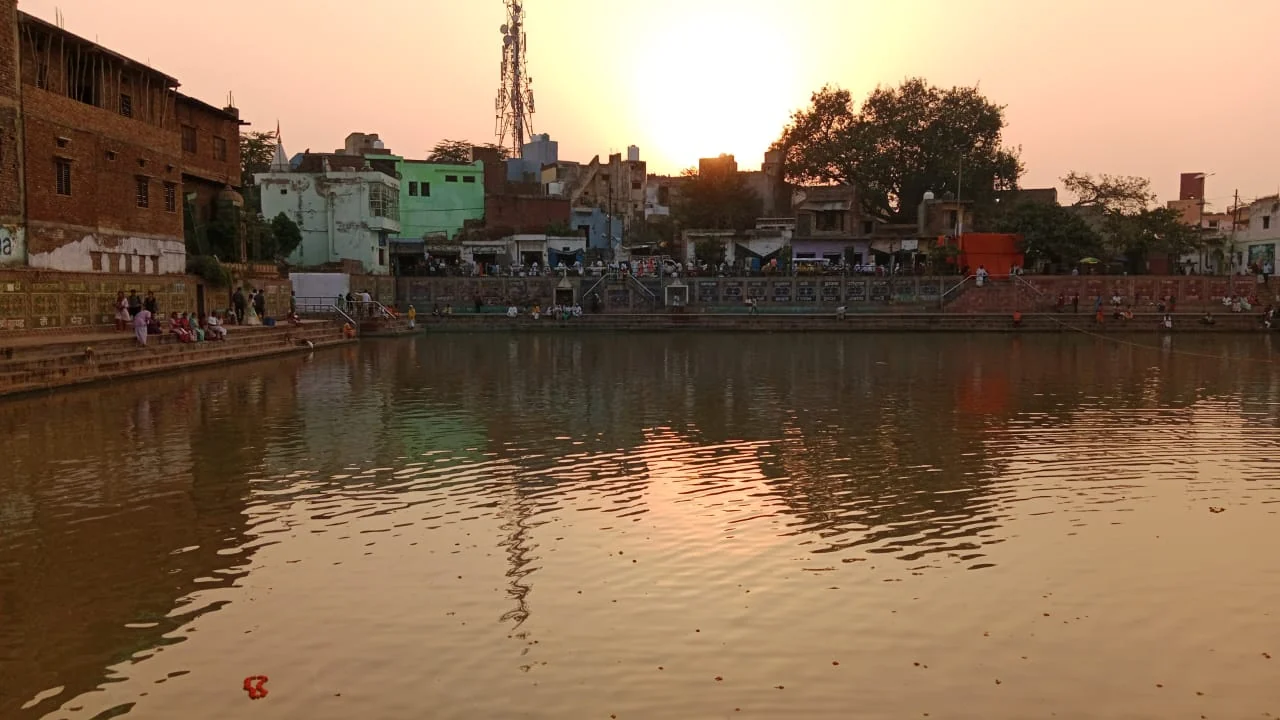
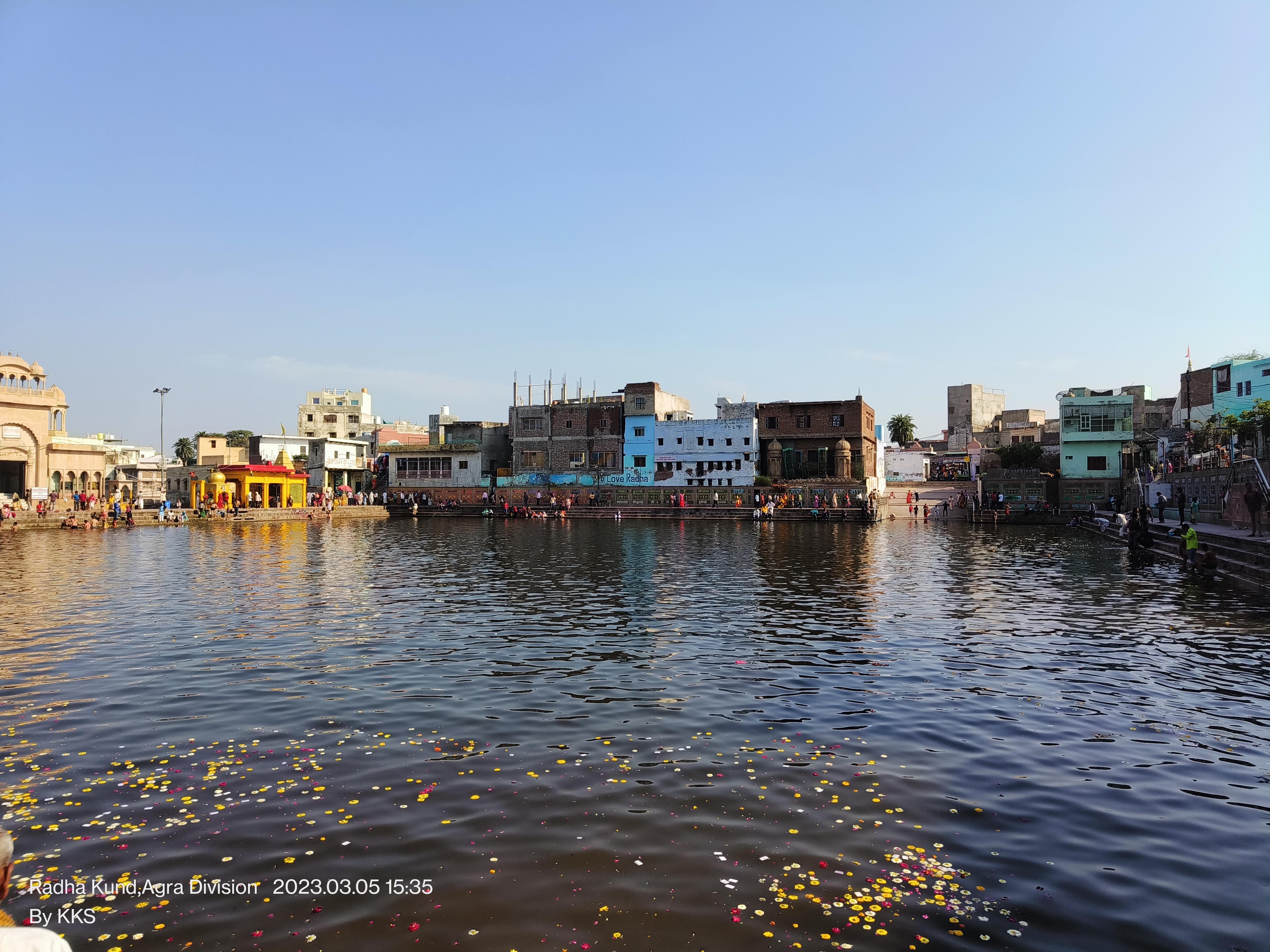
Both days are treated as worshipable. The distinction matters for a pilgrim because it explains why the site looks the way it does today: virtually every structure standing at Rādhā-kuṇḍa, the excavated and stone-lined banks, the ghāṭs, the surrounding temples, postdates Mahāprabhu's rediscovery and was built by the Gosvāmīs He sent to Vraja, principally Raghunātha Dāsa Gosvāmī and Jīva Gosvāmī, who spent their lives excavating, expanding, and physically dwelling at the kuṇḍa.
04
The Kuñjas Surrounding Rādhā-kuṇḍa
According to the Vraja-rīti-cintāmaṇi and the meditative literature that maps Rādhā-kuṇḍa's spiritual topology, the kuṇḍa is surrounded in the eight directions by the kuñjas (bowers, or private garden-groves) of Rādhārāṇī's aṣṭa-sakhīs, Her eight principal confidential gopī associates: Lalitā, Viśākhā, Citrā, Indulekhā, Campakalatā, Raṅgadevī, Tuṅgavidyā, and Sudevī. Each of these eight sakhīs is understood to have personally designed and decorated her kuñja for the sole purpose of pleasing the Divine Couple, and each of these eight major groves is itself said to be encircled by eight smaller groves belonging to that sakhī's own assistant gopīs, an architecture of intimacy nested inside intimacy.
Lalitā's kuñja receives special description in this literature: shaped like a lotus, said to hold the pleasures of all six seasons simultaneously, built with platforms of gold, crystal, sapphire, and lapis lazuli, and named as the largest and dearest of the eight because it is inexhaustibly pleasing.
At the center of Rādhā-kuṇḍa itself, not on the bank, but at the heart of the configuration, is the kuñja of Ananga Mañjarī, Rādhārāṇī's own younger sister in Her mañjarī identity, who serves in the intimate role of arranging meetings and services between Rādhā and Kṛṣṇa. Her placement at the center is theologically significant: it marks Rādhā-kuṇḍa's meditative layout as radiating outward from the innermost act of loving service, with the sakhīs' groves as the layer that both protects and facilitates that center.
None of this is visible to ordinary eyes in the way the physical ghāṭs and temples are. It belongs to the domain of rāgānugā meditation, the practice, cultivated under qualified guidance, of entering Vraja's inner form through remembrance rather than sight. A pilgrim will not be shown "Lalitā's kuñja" with a signboard. But knowing this structure exists is part of understanding why Rūpa Gosvāmī's commentators say a soul who resides at Rādhā-kuṇḍa in perfected consciousness serves the eternal couple's eightfold daily pastimes there directly.
What is physically visible on parikramā
The outer, walkable circuit, the actual pilgrim's route around the two kuṇḍas, roughly 1.5 km and about fifteen to twenty minutes at a normal pace, passes a dense concentration of sites tied to the Gosvāmīs who built this place:
- Kuṇḍeśvara Mahādeva, a temple to Śiva as guardian of the dhāma, near a sacred pīpal tree, close to the first approach to the kuṇḍa.
- Lalitā-kuṇḍa, a smaller sacred pool on the parikramā path, managed at its temple by followers of the Nimbārka sampradāya, from which pilgrims traditionally take water onto the head.
- The bhajana-kuṭīras, small meditation huts, of Jīva Gosvāmī (directly across from Lalitā-kuṇḍa, containing an impression said to be Caitanya Mahāprabhu's footprints), Gopāla Bhaṭṭa Gosvāmī, Kṛṣṇadāsa Kavirāja Gosvāmī (where the Caitanya-caritāmṛta itself was written), and Raghunātha Dāsa Gosvāmī, along with the site where several of these Gosvāmīs were cremated rather than risk their remains being disturbed during periods of persecution.
- The bhajana-kuṭīra of Bhaktivinoda Ṭhākura, used also by Bhaktisiddhānta Sarasvatī Ṭhākura on visits to the area.
- Rādhā-Vinoda Temple, holding the pratibhū (representational) deities of Lokanātha Gosvāmī.
- Gopī-kūpa, a well associated with the recovery of Govardhana's "tongue" (a stone formation) during excavation.
- The Purāṇa Mandira, whose Rādhā-Kṛṣṇa deities were found by Raghunātha Dāsa Gosvāmī while excavating the kuṇḍas.
- A rāsa-sthalī, a circular platform where devotional dance is performed on festival occasions.
- Chaitanya Mahāprabhu's baiṭhaka (seat) and several Gauḍīya Maṭha temples along the road, including one housing the deities of Rādhā-Kuñjabihārī.
Walking this path, a devotee is not touring ruins. Every kuṭīra belonged to someone who chose to live and die at this specific twenty-square-acre site because they had concluded, after mastering the entirety of Gauḍīya philosophy and śāstra, that there was nowhere higher to go.
- Lalita
- Visakha
- Citra
- Indulekha
- Campakalata
- Rangadevi
- Tungavidya
- Sudevi
05
The Mood a Devotee Should Carry There
The Gosvāmīs do not present Rādhā-kuṇḍa only as a place to see. They present it as a place to approach with disciplined humility, because the promise of the kuṇḍa is inseparable from the mood carried to its water.
The promise comes with a precondition
Rūpa Gosvāmī's Upadeśāmṛta does not open with the glorification of Rādhā-kuṇḍa. It opens, in its very first verse, with the instruction to control the urges of speech, mind, anger, tongue, belly, and genitals, because, as the commentarial tradition explains, curbing these six urges is not itself devotional service, but the minimum precondition for making the heart fit to enter devotional service at all. Only after nine more verses of steadily ascending instruction does Rūpa Gosvāmī arrive at the climactic declaration of Rādhā-kuṇḍa's supremacy. That structure is deliberate. The text is telling the reader: this destination is real, but it is not the first step, and approaching it prematurely, in an unprepared or self-indulgent state of mind, inverts the entire purpose of the place.
Rūpa Gosvāmī's own final verse acknowledges this directly, he calls Rādhā-kuṇḍa's prema "rarely attained even by great devotees," meaning the text itself flags that casual or presumptuous approach misreads what is being offered.
The historically recorded warning
There is a well-known and instructive incident from Śrīla Prabhupāda's dealings with his own disciples at Rādhā-kuṇḍa: while a group was bathing, some began splashing and playing in the water in a lighthearted, recreational way. Prabhupāda, seeing this, became visibly upset and for a time prohibited his disciples from bathing there at all. The lesson drawn from this by the tradition is explicit, treating Rādhā-kuṇḍa as a pleasant swimming spot, however innocently, is an offense against Rādhārāṇī, because the water is not a symbol of Her love but is understood to be Her love in manifest form. The instruction that follows is to bathe there the way one would approach the Deity in the temple: with folded hands, with reverence, entering the water right hand and right foot first (following Vaiṣṇava etiquette for approaching anything sacred), and with the internal posture of an offering rather than a leisure activity.
The mood to actually cultivate: humility and service, not premature identification
The tradition is unusually direct that the qualifying mood is not longing to personally participate in the aṣṭakālīya-līlā, nor an attempt to mentally "enter" the confidential pastimes of Rādhā and Kṛṣṇa as if by right. That is treated as a serious misstep, sometimes called jumping over the instructions of the ācāryas, and is reserved, if at all, for a soul who has genuinely reached a liberated, purified stage of practice (what the tradition calls being firmly acyuta, unfallen from the platform of pure devotional service) under qualified guidance, not something a pilgrim should attempt to conjure by sentiment on a first visit.
What is prescribed instead, and what Raghunātha Dāsa Gosvāmī's own life is held up as the living demonstration of, is a mood of humility, service, and longing rather than entitlement. Raghunātha Dāsa Gosvāmī, after renouncing vast wealth and family position, lived at Rādhā-kuṇḍa performing a fixed daily discipline: circumambulating the kuṇḍa while counting the holy names, singing, and offering prostrated obeisances (daṇḍavat-parikramā) at intervals along the path, a practice so demanding it visibly reduced his body over the years, and which the tradition still names as the template for what it means to be a "Rādhā-kuṇḍa-vāsī," a resident of the kuṇḍa in spirit. His own Rādhā-kuṇḍāṣṭaka and Vraja-vilāsa-stava express not proximity claimed as achievement, but a servant's aching desire simply to be allowed to remain.
In practical terms, for a pilgrim today
- Approach the water the way you would approach an altar, with folded hands and a bow, not as a scenic bathing spot or a photo backdrop.
- If you bathe, do so with the intention of an offering: right hand and foot entering first, and an internal prayer for the qualification to serve rather than a request for personal pleasure or attainment.
- Recognize that the accompanying pastime histories, the "amorous," "unobstructed" language used to describe Rādhā and Kṛṣṇa's meetings here, describe the object of the highest devotion, not an invitation for the pilgrim's imagination to insert itself into that intimacy. The proper devotional response to hearing these pastimes is increased humility and a longing to serve the servants of Rādhā, not a sense of personal access.
- Keep noise, joking, and recreational behavior out of the immediate kuṇḍa area, especially at the ghāṭs; this is the specific behavior that provoked Prabhupāda's documented rebuke.
- If possible, walk the full parikramā slowly rather than rushing it, the Gosvāmīs' kuṭīras along the path are not incidental stops but the actual curriculum: each one represents a life spent demonstrating, rather than merely writing about, the mood this place demands.
- Treat repeated visits, or an extended stay, as the tradition's own recommended practice, Rūpa Gosvāmī's tenth Upadeśāmṛta verse concludes that the mature instruction is not a single visit but to take shelter of Rādhā-kuṇḍa and render service there for the remainder of one's life, a standard almost no visiting pilgrim will literally meet, but one that should inform the seriousness with which even a short visit is undertaken.
06
Closing
Rādhā-kuṇḍa does not function, in Gauḍīya theology, as a shrine commemorating something that happened once. It is treated as a living, non-different manifestation of Rādhārāṇī's own body of love, still the site, according to the tradition's own cosmology, of Rādhā and Kṛṣṇa's unobstructed daily pastimes in a dimension screened from material eyes. The physical kuñjas of the eight sakhīs, the kuṭīras of the Gosvāmīs, the two adjoining ponds themselves: all of it is presented by the ācāryas as furniture arranged around a single point, that here, more than anywhere else in creation, the tradition holds that pure love for Kṛṣṇa becomes attainable. Whether a pilgrim receives anything of that promise, the tradition is consistent on one point: it depends entirely on the humility carried to the water's edge.
Honor before contact
Approach the water with the same seriousness you would bring before a temple altar.
Service before attainment
The proper aspiration is qualification to serve, not a claim of personal access.
Parikrama before haste
The slow circuit lets the Gosvami sites instruct the mood of the visit.
Continue with Vraja Maṇḍala Darśana
Radha-kunda belongs to the deeper Govardhana and Vraja circuit. Continue into guided darśana for context, route sequence, etiquette, and careful parikrama planning.
Continue with Vraja Maṇḍala DarśanaImage Credits and References
Images: Radha Kund by Krishna Kant Sharma, Radha Kund evening by Srinath chinmayee2230949, and Prema Dhvani Vraja photography assets.
Reference pages consulted for expansion and verification: Upadeśāmṛta 9, Upadeśāmṛta 10, Upadeśāmṛta 11, Śrīmad-Bhāgavatam 10.36, Mayapur: Appearance of Śrī Rādhā-kuṇḍa, Sri Narasingha Chaitanya Ashram: Appearance of Rādhā-kuṇḍa, and Radha-kund Parikrama notes.