
01
Bengal, late fifteenth century
An Unexpected Beginning
If one spends time among devotees who chant the holy name, one soon hears the name of Śrīla Haridāsa Ṭhākura. He is remembered as Nāmācārya, the ācārya of the holy name. This title was not given to him merely because he spoke eloquently about chanting. His authority came from the life he lived.
Haridāsa chanted in solitude and carried the holy name from door to door. He endured public persecution without hatred. He transformed people who approached him with hostile intentions. He explained the power of even an incomplete awakening of the name, yet regarded love of Kṛṣṇa as far greater than liberation. Above all, his life revealed the relationship between the devotee who takes shelter of the holy name and the Lord whose name is being chanted.
Traditional Gauḍīya accounts locate his appearance in the region of present-day Bangladesh, commonly identifying his birthplace with Buḍhana or Buron in the former Jessore district. He appeared in, or according to some accounts was raised within, a Muslim family.
Bengali society at the time was divided by strong religious and social boundaries. Birth determined much of a person's public identity. Yet Haridāsa became deeply attached to the names of Kṛṣṇa. The surviving accounts do not provide a detailed record of his childhood or explain how this attraction first arose. They introduce him when his life had already become centered upon chanting.
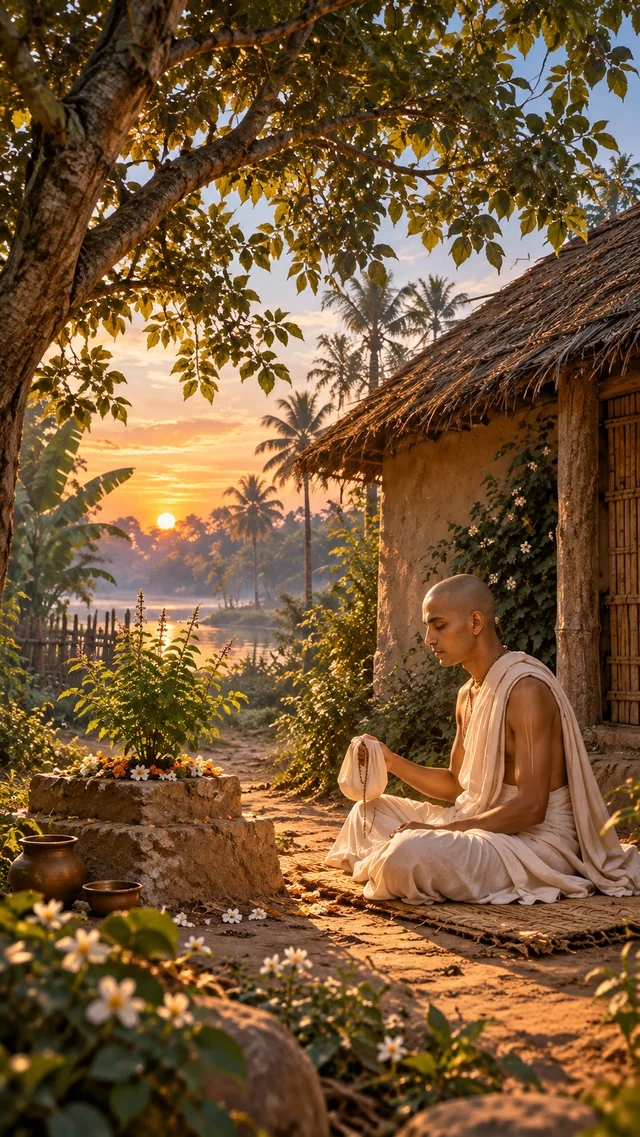
He eventually lived in places such as Benāpola, Phuliyā and Śāntipura. Wherever he stayed, his way of life remained simple. He kept a tulasī plant near him, possessed very little and spent most of his time chanting. He undertook the extraordinary daily vow of chanting three hundred thousand names of the Lord. This was not an occasional austerity performed for recognition. It was his daily service.
Learned brāhmaṇas and ordinary villagers began to respect him. Some came to hear him chant. Others brought food or simply sat nearby. His presence quietly challenged the assumption that spiritual qualification could be measured by ancestry. Not everyone welcomed that challenge.
02
The Attempt to Destroy His Character
While Haridāsa was living near Benāpola, a powerful landholder named Rāmacandra Khān became disturbed by the honor people offered him. Haridāsa had not challenged the landholder or sought his position. His only offense was that people had begun to recognize genuine devotion in someone whom society did not expect to honor.
Unable to find a fault in Haridāsa's conduct, Rāmacandra Khān decided to manufacture one. He summoned a young prostitute and instructed her to seduce Haridāsa. Once they were found together, the landholder intended to expose him publicly and destroy his reputation.
The woman dressed attractively and came to Haridāsa's hut at night. She bowed before the tulasī plant, sat at the entrance and tried to attract his attention. Haridāsa listened without agitation. He told her that he would satisfy her desire, but first she would have to wait until he had completed his prescribed chanting. She sat near him while he continued repeating the names of Kṛṣṇa. The night passed, dawn arrived and Haridāsa had still not finished his vow.
She returned the following evening. Haridāsa again asked her to sit and listen until his chanting was complete. As the hours passed, she began repeating the name of Hari herself. On the third night, her purpose changed completely.
After continuously hearing the holy name, she fell at his feet and confessed that Rāmacandra Khān had sent her to corrupt him. She no longer wanted to deceive him and asked him to deliver her from the life she had been leading.
Haridāsa told her that he had known about the conspiracy from the beginning. He could have left immediately, but he remained for three nights because he wanted her to receive the mercy of the holy name. He instructed her to distribute her possessions, remain in the hut, chant continuously and serve the tulasī plant. She followed his instructions and became a respected Vaiṣṇavī.
Haridāsa did not defeat an enemy. He saw a person trapped within the intentions of another and waited patiently until hearing the holy name awakened her desire for a different life.
03
Beaten Through Twenty-Two Marketplaces
Haridāsa's public chanting also disturbed religious authorities. A man born within the Muslim community was now openly devoted to Kṛṣṇa, and his influence was increasing.
He was arrested and brought before a regional ruler, identified in the accounts as the Mulukpati. The ruler questioned why he had abandoned the religious conduct associated with his birth. Haridāsa answered without hostility. God is one, he explained, although different scriptures and communities may call Him by different names. The Lord directs every person from within the heart.
The authorities ordered him to stop chanting the names of Kṛṣṇa. Haridāsa refused. He declared that even if his body were cut into pieces and his life departed, he would not abandon the holy name.
He was sentenced to be beaten publicly through twenty-two marketplaces. The authorities expected the beating to kill him and warn others against following his example. The executioners dragged him from one marketplace to another and struck him repeatedly. Haridāsa continued chanting. Rather than praying for his own relief, he prayed for the men who were beating him.
When the executioners saw that he remained alive, they became terrified. They told him that the ruler would kill them for failing to carry out the sentence. Concerned for their lives, Haridāsa entered a state resembling death. Believing that he had finally died, the officials ordered his body to be thrown into the Gaṅgā.
Haridāsa entered the river and later emerged alive. He resumed chanting as before. The ruler asked forgiveness and gave him freedom to chant wherever he wished.
Years later, during the great revelation known as the mahā-prakāśa at the home of Śrīvāsa Ṭhākura, Śrī Caitanya Mahāprabhu disclosed what had occurred during the beating. The Lord told Haridāsa that He could not tolerate the blows falling upon His devotee. Because Haridāsa had prayed for the forgiveness of his persecutors, the Lord did not punish them. Instead, He protected Haridāsa and accepted the blows upon Himself.
Haridāsa had appeared helpless and alone before the authorities. Mahāprabhu revealed that He had never left him.
04
With Advaita Ācārya at Śāntipura
Haridāsa spent significant time near Advaita Ācārya in Śāntipura. Advaita recognized his spiritual position and treated him with deep affection. This was socially bold. Advaita was a highly respected brāhmaṇa and scholar. By publicly honoring Haridāsa, he challenged those who believed birth to be more important than devotion.
During a śrāddha ceremony for his ancestors, Advaita offered the principal honor and prasāda to Haridāsa. Haridāsa hesitated, fearing that Advaita would be criticized for honoring someone of his background. Advaita replied that feeding Haridāsa was equal to feeding countless brāhmaṇas.
Their connection went deeper than social convention. Advaita worshiped the Lord and loudly called for Kṛṣṇa to descend into the world. Haridāsa performed nāma-saṅkīrtana with the same longing. The Gauḍīya tradition remembers their prayer and chanting as part of the call that brought Śrī Caitanya Mahāprabhu into the world.
Haridāsa was therefore not someone who merely joined Mahāprabhu's movement after it had begun. His chanting helped prepare the ground for the Lord's appearance and mission.
05
The Power of the Name
At Cāndapura, Haridāsa stayed with Balarāma Ācārya and was received in the assembly of Hiraṇya and Govardhana Majumadāra. There an important discussion arose concerning the power of the holy name.
Haridāsa explained that even nāmābhāsa, a partial or indistinct awakening of the holy name, could free a person from material bondage. It was like the first light before sunrise. The sun might not yet be visible, but its early rays already began to remove the darkness.
A young tax collector named Gopāla Cakravartī could not accept this conclusion. He argued that liberation could not be obtained so easily and insulted Haridāsa before the assembly. He declared that if Haridāsa's statement proved true, Haridāsa's nose should be cut off.
Haridāsa defended the scriptural conclusion, but when the young man continued speaking offensively, he simply left. The members of the assembly dismissed Gopāla Cakravartī from his position. Haridāsa asked them not to blame him. The young man, he said, depended upon dry logic and therefore could not understand the glory of the holy name. Haridāsa prayed that Kṛṣṇa would bless him.
His teaching about nāmābhāsa did not mean that liberation was the highest fruit of chanting. He explained that liberation was insignificant to a devotee who had begun to taste loving service to Kṛṣṇa. The true gift of the holy name was not simply release from suffering. It was love of God.
06
The Lord Appears in Navadvīpa
When Śrī Caitanya Mahāprabhu revealed His devotional mission in Navadvīpa, Haridāsa became one of His principal associates. Mahāprabhu placed him alongside devotees such as Advaita Ācārya, Śrīvāsa Ṭhākura and Nityānanda Prabhu. The person whom society had attempted to exclude was placed near the center of the saṅkīrtana movement.
Mahāprabhu instructed Nityānanda Prabhu and Haridāsa to go from house to house and ask everyone they met to chant Kṛṣṇa's name, worship Kṛṣṇa and learn about Kṛṣṇa.
The pair made a striking combination. Nityānanda was fearless, unpredictable and overflowing with compassion. Haridāsa was mature, steady and deeply humble. Together they approached respectable homes, ordinary villagers and people whom others avoided.
During this preaching they encountered Jagāi and Mādhāi, two brothers notorious for drunkenness and violence. When the brothers chased them, Nityānanda and Haridāsa ran for safety. Haridāsa humorously blamed Nityānanda for leading them into danger, but their mission did not stop. Nityānanda later returned, and through His mercy both brothers were delivered.
Haridāsa's life had already shown that the holy name was not restricted by birth. The deliverance of Jagāi and Mādhāi showed that it was not restricted by a person's past conduct either.
07
Humility at Siddha Bakula
After Śrī Caitanya Mahāprabhu accepted sannyāsa and made Jagannātha Purī His residence, Haridāsa joined Him there. Mahāprabhu arranged a place for him near the residence of Kāśī Miśra. The site became known as Siddha Bakula. Haridāsa remained there, chanting beneath the bakula tree and receiving devotees who came to see him.
Although Mahāprabhu and His associates regarded him as an exalted Vaiṣṇava, Haridāsa did not enter the temple of Lord Jagannātha. Conscious of the social conventions surrounding his birth, he considered himself unqualified to enter. His decision was not a rejection of Jagannātha. It arose from his profound humility and unwillingness to create social disturbance.
Mahāprabhu told him to remain at Siddha Bakula, where he could see the temple's cakra from a distance and offer obeisances. Prasāda from Lord Jagannātha was brought to him regularly. Mahāprabhu also visited him. On His way to bathe in the sea, He would stop at Siddha Bakula and speak with Haridāsa. The Lord whom thousands struggled to see in the temple came personally to the devotee who considered himself unfit to enter.
Their conversations reveal the breadth of Haridāsa's compassion. When Mahāprabhu asked how people distant from Vedic culture could be delivered, Haridāsa expressed complete faith in the holy name. Even when someone pronounced the name indirectly, jokingly or imperfectly, contact with that name could begin spiritual purification. Loud chanting benefited not only the chanter but every living being able to hear it.
Haridāsa did not use this teaching to minimize attentive chanting. His own life was one of extraordinary discipline. He understood that Kṛṣṇa had invested His name with a mercy far greater than human beings could measure.
08
The Final Days
As Haridāsa grew old, his body became weak. One day Mahāprabhu's servant Govinda came with Jagannātha prasāda and found him lying down, softly chanting.
Govinda asked him to rise and honor the prasāda. Haridāsa replied that he had not completed his daily number of names. He did not want to eat before completing his vow, but he also could not neglect mahā-prasāda. He therefore honored a small portion.
The next day Mahāprabhu came and asked about his health. Haridāsa answered that his body was not his real illness. His difficulty was that he could no longer complete his daily chanting. Mahāprabhu told him that he was already spiritually perfect and that, because of his advanced age, he could reduce his count.
Haridāsa did not regard himself as perfect. He understood that Mahāprabhu would soon conclude His manifest pastimes, and he did not wish to remain in the world to witness that separation. He asked permission to depart first. He wanted to place Mahāprabhu's lotus feet upon his heart, look upon His moonlike face and chant the name “Śrī Kṛṣṇa Caitanya” as he left his body.
Mahāprabhu told him that Kṛṣṇa would fulfill his desire, although the Lord also said that separation from Haridāsa would be difficult to bear.
On the following day, Mahāprabhu came to Siddha Bakula with His devotees. They surrounded Haridāsa and began saṅkīrtana. Vakreśvara Paṇḍita danced, while devotees such as Svarūpa Dāmodara and Rāmānanda Rāya remained near the Lord.
Haridāsa praised the devotees and placed the dust of their feet upon his head. Then he brought Śrī Caitanya Mahāprabhu's feet to his heart. Looking upon the Lord's face, he repeatedly chanted, “Śrī Kṛṣṇa Caitanya.” With the Lord's feet upon his chest and the holy name upon his tongue, Haridāsa Ṭhākura departed from the world.
09
Honored by the Lord
Śrī Caitanya Mahāprabhu lifted Haridāsa's body into His arms. Holding him close, the Lord began to dance in kīrtana. The assembled devotees surrounded Him, chanting loudly.
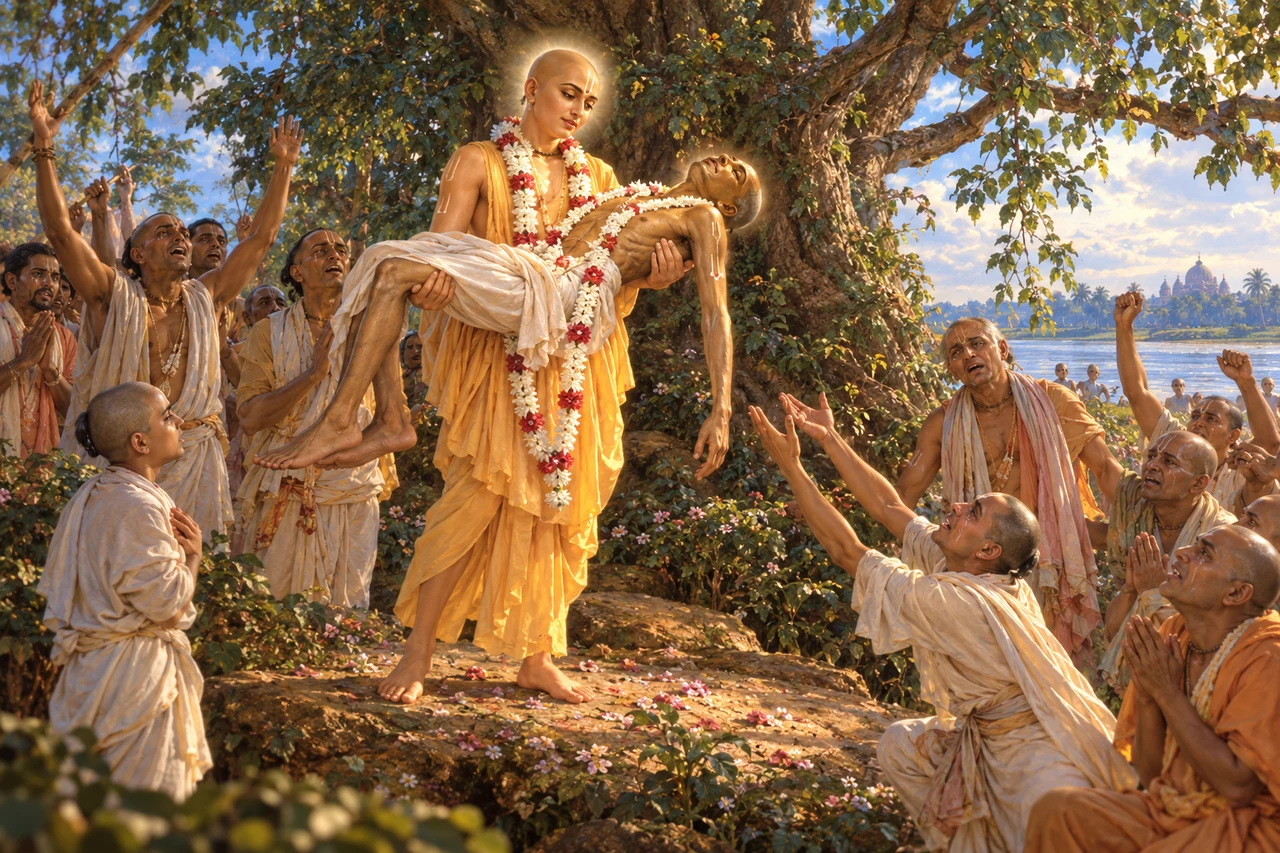
Mahāprabhu personally joined the procession carrying Haridāsa to the sea. His body was bathed there, and the Lord declared that the ocean had become a great place of pilgrimage by touching him. The devotees drank and sprinkled upon themselves the water that had washed his feet.
A resting place was prepared in the sand. Haridāsa's body was placed there with Jagannātha prasāda, sandalwood paste and sacred cloth. Mahāprabhu personally covered him with sand and helped raise a platform over the place.
The Lord then bathed in the sea with the devotees and returned toward the Siṁha-dvāra gate of the Jagannātha temple. Spreading out His cloth, He personally begged prasāda from the shopkeepers for a festival honoring Haridāsa. Large quantities were collected. Mahāprabhu seated the devotees in rows and wanted to serve each of them personally.
Mahāprabhu described Haridāsa as the crest jewel of the world and said that the earth had lost a precious jewel. The Lord had shown the world how a devotee should be honored.
Why He Is Called Nāmācārya
Haridāsa Ṭhākura is called Nāmācārya because every part of his life taught something about the holy name. His birth showed that the name is not inherited through caste or ancestry. His daily vow showed that chanting is worthy of sustained attention and sacrifice. His encounter with the prostitute showed that hearing the name can redirect an entire life.
The twenty-two marketplaces showed that the name remains with the devotee even when every external shelter has been taken away. His forgiveness of his persecutors showed that genuine chanting softens the heart rather than filling it with self-righteousness. His explanation of nāmābhāsa showed that the Lord has placed immense mercy within His name. His preaching with Nityānanda Prabhu showed that the name is not private property.
His life at Siddha Bakula showed that humility does not make a devotee distant from the Lord. It draws the Lord near. His departure showed the completion of a life centered on remembrance: Mahāprabhu's feet upon his heart, Mahāprabhu's face before his eyes and Mahāprabhu's name upon his tongue.
Gauḍīya tradition identifies him as Brahmā Haridāsa, Lord Brahmā appearing in the role of a humble servant of the holy name. Yet Haridāsa never sought recognition for an exalted identity. He consistently presented himself as fallen and dependent upon mercy.
For someone newly approaching his life, Haridāsa does not leave behind a complicated formula. He leaves an invitation: begin chanting, continue chanting, hear carefully, remain humble, give the name to others and trust that Kṛṣṇa is present within it.
The world tried to define Haridāsa by his birth, discredit him through temptation, silence him through violence and defeat his conclusions through argument. None of these efforts succeeded. He answered each of them in the same way.
He continued to chant.
Image Credits and References
Hero and departure images: original devotional artwork supplied for this Prema Dhvani article.
Principal Gauḍīya sources include Caitanya-caritāmṛta Antya-līlā 3, Caitanya-caritāmṛta Antya-līlā 11, Caitanya-caritāmṛta Ādi-līlā 17, and the accounts of Haridāsa Ṭhākura in the Caitanya-bhāgavata.