
01
A Boy in Śrī Raṅgam
The story of Rādhā-ramaṇa cannot be told without first telling the story of the man through whom He appeared: Śrī Gopāla Bhaṭṭa Goswāmī, one of the Six Goswāmīs of Vṛndāvana.
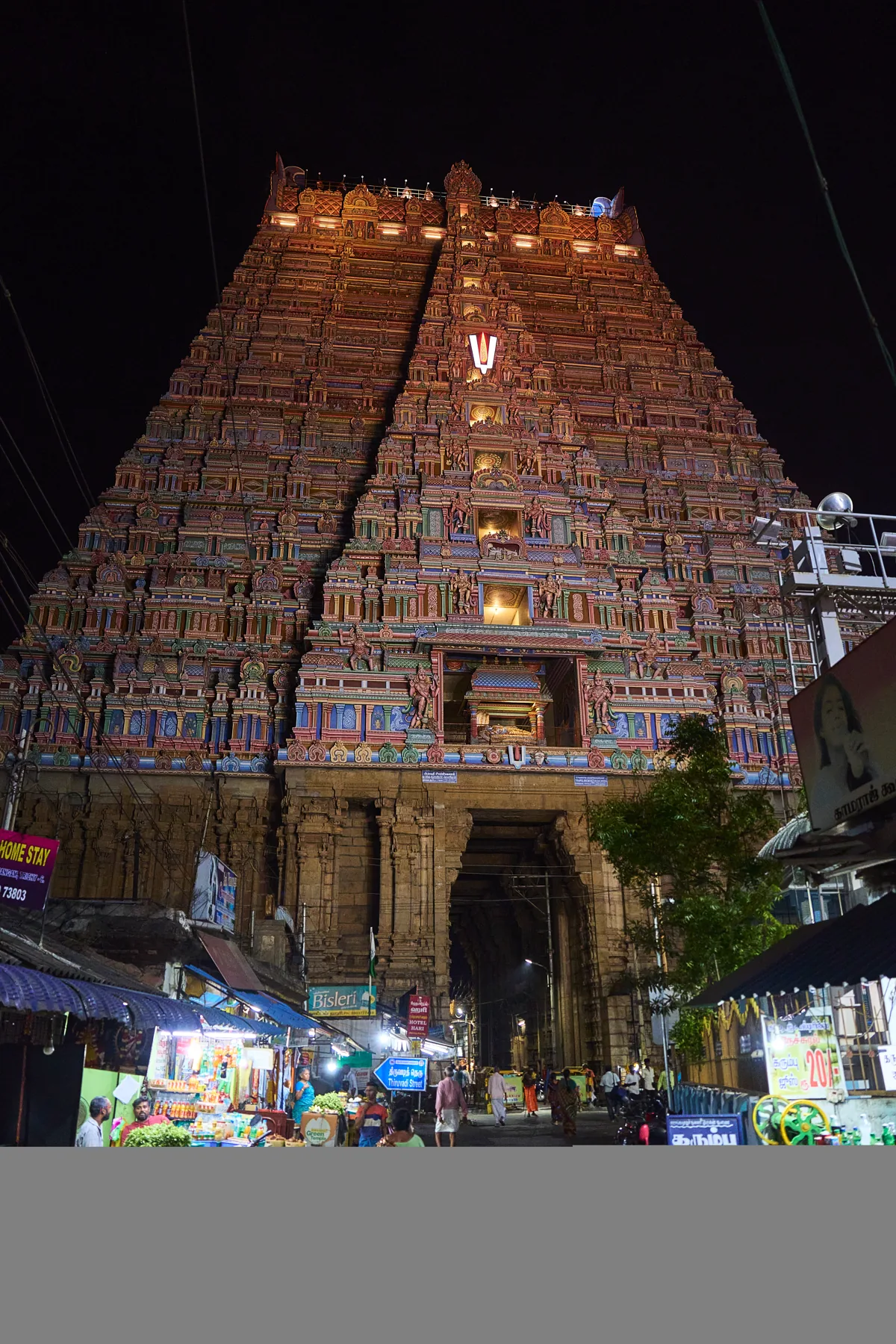
He was born around 1503 CE in Śrī Raṅgam, South India, into a family that stood at the very center of Śrī Vaiṣṇava religious life. His father, Veṅkaṭa Bhaṭṭa, was a devout brāhmaṇa in the disciplic line of Rāmānujācārya, and , depending on the account , either the head priest or a senior figure of authority at the great Raṅganātha temple, the largest Viṣṇu temple in India. Veṅkaṭa Bhaṭṭa had two brothers, Tirumalla Bhaṭṭa and the formidable scholar Prabodhānanda Sarasvatī, who would later become both Gopāla's uncle, first teacher, and initiating guru.
Around 1510-1511, during a two-year walking pilgrimage through South India, Śrī Caitanya Mahāprabhu arrived in Śrī Raṅgam during the four rainy months of cāturmāsya , the traditional season when wandering renunciates settled in one place , and was invited to stay in Veṅkaṭa Bhaṭṭa's home. He remained there the entire four months.
Gopāla was a small child at the time, said to be somewhere between five and seven years old. Mahāprabhu grew genuinely fond of him , lifting him onto His lap, feeding him remnants of His own prasādam, laughing and joking with the family in a mood later described as sakhya-rasa, the intimacy of friendship. It was a rare closeness, and it marked the boy for life.
During this stay, Mahāprabhu is remembered to have won over the entire household , not through argument, but through a single exchange of questions with the learned Veṅkaṭa Bhaṭṭa. Mahāprabhu asked why Lakṣmī, the eternal consort of Nārāyaṇa, desired to join Kṛṣṇa's rāsa dance in Vṛndāvana, yet could never actually enter it. Veṅkaṭa Bhaṭṭa could answer the first half , that Kṛṣṇa and Nārāyaṇa are one Truth, though Kṛṣṇa holds the higher position in matters of intimate rasa , but the second question defeated him completely. He admitted, humbly, that only the one who asked such a question could know its answer. Mahāprabhu then explained: Lakṣmī could not enter the rāsa because she retained the identity and the very form of Lakṣmī. Entry into that dance requires a gopī-bhāva , the specific loving disposition of a cowherd maiden , not merely proximity or desire. Hearing this, Veṅkaṭa Bhaṭṭa recognized Kṛṣṇa-bhakti as supreme, and the family converted, in that hour, from Śrī Vaiṣṇavism to Gauḍīya Vaiṣṇavism. The young Gopāla, for his part, is said to have had his own dream-vision during this period, seeing that the pastimes of Navadvīpa and the pastimes of Vṛndāvana were, at their root, not different at all.
Before leaving, Mahāprabhu gave the boy his life's instructions: stay with your parents, serve them until they leave this world, and only then travel to Vṛndāvana. But He added one more thing , on the way, go first to the Himālayas, to the river Gaṇḍakī, and bring back śālagrāma-śilās for worship. In this single instruction, tradition holds, Mahāprabhu planted the seed of śālagrāma worship , a devotional practice with roots in scriptural regulation , into a sampradāya otherwise oriented entirely around spontaneous, unregulated love (rāga-mārga). It was not incidental. It was preparation for something specific.
02
The River That Gave Twelve Stones
Years passed. Gopāla took formal initiation from his uncle Prabodhānanda Sarasvatī and remained in Śrī Raṅgam, tending to his aging parents as instructed. When they finally passed from this world, he set out , not directly for Vṛndāvana, but north, toward the Himālayas, to fulfill Mahāprabhu's forgotten-sounding but precise instruction.
At the Gaṇḍakī river, he entered the water to bathe and dipped his water pot beneath the surface. When he lifted it, twelve śālagrāma-śilās , the naturally occurring ammonite stones understood in Vaiṣṇava tradition to be a direct, unmanufactured form of Viṣṇu , had entered the pot on their own. Startled, feeling it was not his place to claim so many sacred stones, he poured them back into the river and refilled the pot. The same twelve śilās returned. He is said to have repeated this once more, with the same result, before finally accepting what was being given to him , that these particular stones intended to travel with him. He gathered them into a cloth, tied it, and carried it around his neck for the rest of the journey.
On the road to Vṛndāvana, he stopped along the way and initiated three Bengali brāhmaṇas into Vaiṣṇava practice, bringing them onward with him. When he finally reached Vṛndāvana, he took shelter of Rūpa Goswāmī and Sanātana Goswāmī, who were already established there, and began his life as one of the wandering renunciate scholars who would come to be known as the Six Goswāmīs.
He lived, by every account, exactly as they did: no fixed residence, sleeping wherever night found him , often in the forest groves (kuñjas) along the Yamunā , surviving on alms, and devoting every remaining hour to scriptural study, writing, and the daily worship of his twelve śilās, which he kept sometimes in the cloth bag around his neck and sometimes hanging in a basket from the branch of the tree under which he happened to be staying.
03
A Quiet Ache
Something sat unresolved in Gopāla Bhaṭṭa during these years , not a complaint, but a longing. A śālagrāma-śilā is worshipped as fully and completely divine; nothing about its round, unadorned form is considered lesser. And yet it cannot be dressed. It has no hands to hold a flute, no feet for anklets, no face to smile. Gopāla Bhaṭṭa wanted, quite simply, to see the Lord's form , to look into His eyes, to dress Him, to decorate Him the way one adorns someone deeply loved. This wish is present, gently, in nearly every surviving account of what happened next.
There was a second ache running alongside it. Before parting in Śrī Raṅgam, Mahāprabhu had told Gopāla Bhaṭṭa he would receive His darśana again one day. But the years went on, and Mahāprabhu remained in Puri, absorbed in His own final pastimes, never returning to Vṛndāvana in person. What arrived instead were tokens sent through others , at one point, on hearing that Gopāla Bhaṭṭa had settled in Vṛndāvana, Mahāprabhu sent him renunciate garments (kaupīna) through a messenger, along with His own wooden sitting plank (pīṛha) and a cloth He had personally used, as a gesture of blessing. Gopāla Bhaṭṭa received these as direct mercy and prasādam, and , remarkably , they are still preserved and used in worship at the Rādhā-ramaṇa temple today, nearly five hundred years later. But the promised second darśana, face to face, had not come. That unfulfilled promise stayed with him.
04
The Merchant's Gift
Into this quiet longing walked an unnamed wealthy devotee , referred to in most accounts simply as a "Seth" , who arrived in Vṛndāvana, was deeply moved by Gopāla Bhaṭṭa's evident sanctity, and wished to render some service. He offered fine cloth and ornaments, the kind used to dress a Deity.
Gopāla Bhaṭṭa tried to decline, or at least redirect the gift. His śālagrāmas were round stones; there was nothing on them to drape cloth over, nowhere for a necklace to sit. He suggested the merchant find someone who actually worshipped a Deity in humanlike form. But the merchant insisted, refusing to take anything back. Gopāla Bhaṭṭa, with no other option, accepted the offering and set it down before his śilās , an offering he had, in the most literal sense, nothing to do with.
That evening he performed his usual worship , āratī, an offering of food , and put the śilās to rest for the night, covering the basket carefully and hanging it, in most tellings, from the branch of the tree where he was staying.
05
The Night It Happened
This is the heart of the story, and it is also where the surviving accounts differ most in their small details , though never in their essential shape. What follows is the fullest composite of what has been passed down.
Most accounts place the event on Nṛsiṁha-caturdaśī, the appearance day of Lord Nṛsiṁhadeva , the half-lion, half-man form of Viṣṇu who tore through a stone pillar to save His devotee Prahlāda. Sitting with the day's significance, and perhaps with his own two-fold ache , the unusable gift, the unfulfilled promise of darśana , Gopāla Bhaṭṭa found himself dwelling on how the Lord had once emerged, bodily, from something as unyielding as solid rock. If Nṛsiṁha could come forth from a pillar, could the Lord not also come forth from a stone in his own worship?
He prayed, in the plain and searching language every version preserves in spirit if not in exact wording: that he wished to serve the Lord in a form with arms, with legs, with a smiling, lotus-eyed face , a form he could finally dress in the ornaments sitting unused before him. He read through the Nṛsiṁha-līlā in the Śrīmad-Bhāgavatam, and , overcome , fell into a kind of ecstatic unconsciousness.
One well-preserved account (a 1997 oral history from Swami B. V. Tripurari, transmitting older tradition) places this collapse instead on Buddha Jayantī, and adds a striking physical detail found nowhere else: when Gopāla Bhaṭṭa came back to his senses, he noticed the lid of the hanging basket had come slightly ajar. Thinking a snake might have gotten inside, he reached to push the lid firmly shut , and it would not close. Puzzled, he opened it instead.
There, among the eleven remaining śālagrāmas, stood a Deity.
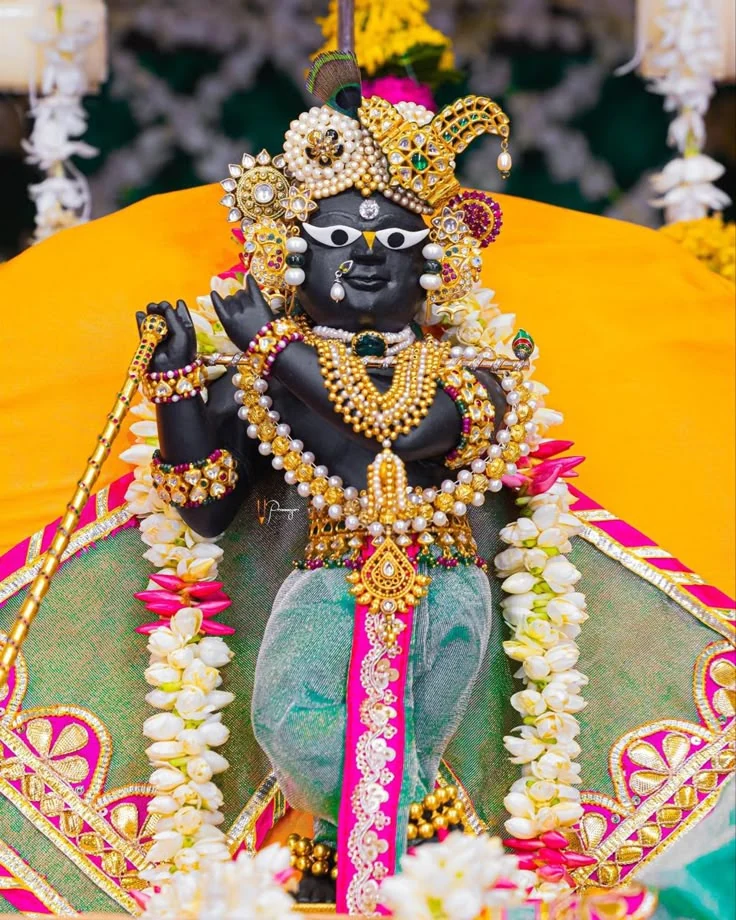
The Dāmodara-śilā , one specific stone among his twelve, previously indistinguishable from the rest , had transformed into a dark, radiant form of Kṛṣṇa standing in tribhaṅga, the graceful three-bend posture, a flute raised to His lips. He is described as roughly eight to eleven and a half inches tall, depending on the source, with a level of bodily detail , fingernails, even teeth , almost never seen in a hand-carved mūrti, let alone one that no sculptor's chisel had ever touched. Faint traces of the original stone's surface are said to remain visible along the back of the form to this day.
Most sources place this appearance on Vaiśākha-śukla-pūrṇimā , the full moon of the month of Vaiśākha (roughly April-May), the day immediately following Nṛsiṁha-caturdaśī , in the year 1542 CE. (One later source gives 1532 CE instead; the great majority of traditional and temple sources agree on 1542, and that is the date generally cited today.)
06
"He Who Delights Rādhā"
Word reached Rūpa and Sanātana Goswāmī almost immediately, and they came running, along with other devotees, to see for themselves what had occurred. Every account agrees on the emotional pitch of that morning: the assembled Goswāmīs wept, openly and without restraint, gazing on a form that seemed to answer every private longing they too carried for the Lord's tangible presence.
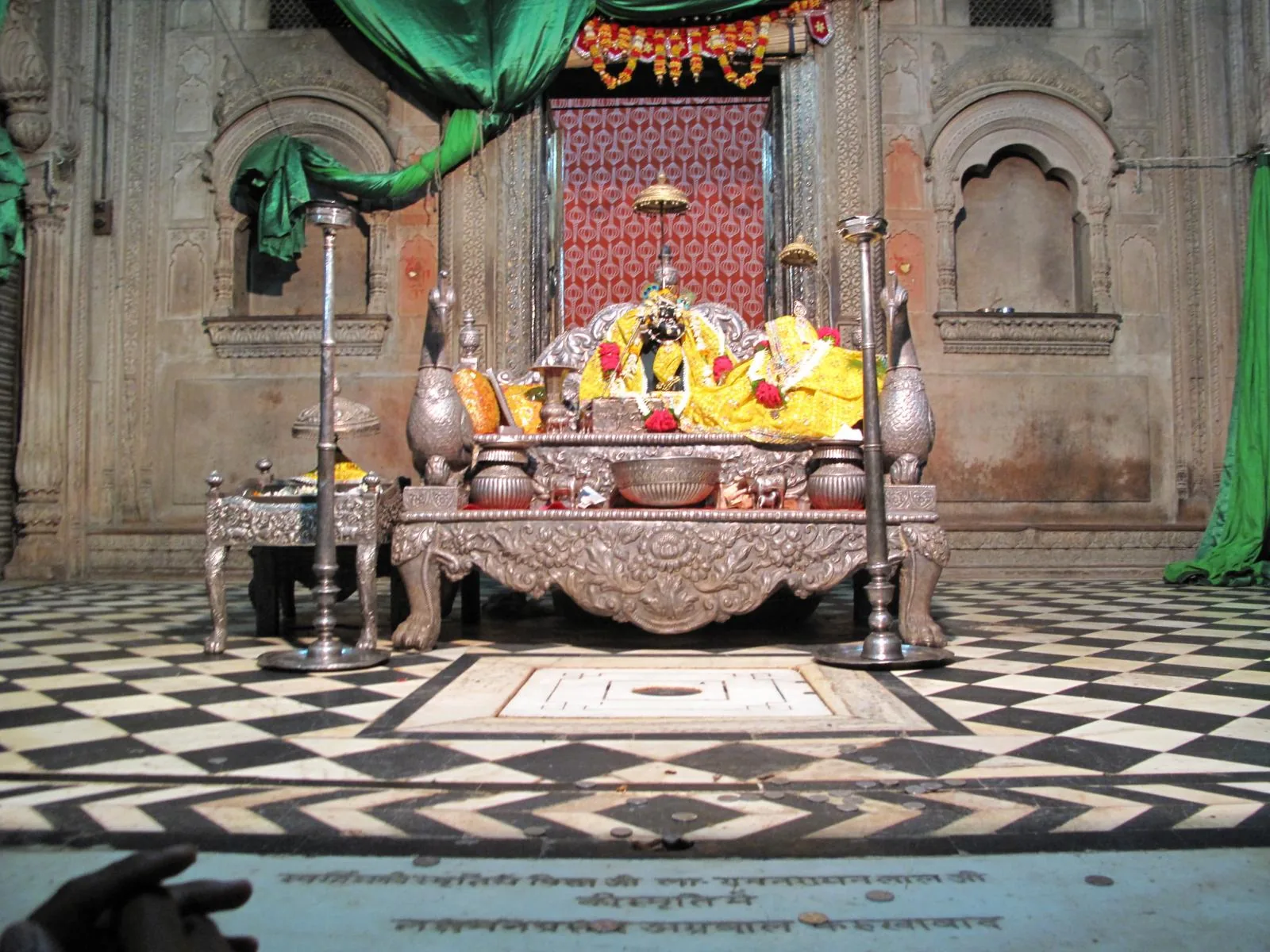
Together, they named the new Deity Rādhā-ramaṇa , "the one who gives pleasure to Rādhā," or more simply, "the enjoyer of Rādhā." It is a name, notably, that speaks of Two even though the form standing before them was One. To this day, the temple keeps no separate mūrti of Rādhārāṇī , there has never been a second Deity beside Him , yet devotees are taught that Her name and Her presence are never, in truth, separate from His. A place is still set at His side in worship, as though for Her, because scripture holds that the name and the person named are not different. Look closely enough at Rādhā-ramaṇa, worshippers say, and you find Her there too.
Some within the tradition go a step further, reading Rādhā-ramaṇa's appearance as the actual fulfillment of Mahāprabhu's long-unmet promise of a second darśana , since Caitanya Mahāprabhu Himself is theologically understood to be Rādhā and Kṛṣṇa combined in a single form. In this reading, the Lord did not fail to keep His word to the grieving boy from Śrī Raṅgam. He simply kept it in a form no one had expected.
Gopāla Bhaṭṭa, along with the other Goswāmīs, held a grand celebration on the spot. And at last , after everything , he was able to dress his Lord in the very ornaments the insistent merchant had left behind, the ones that had sat useless before round stones for who knows how long. The waiting was over. The Lord had a face to receive them.
Read Gopāla Bhaṭṭa Goswāmī's Full Life
For the complete account of Gopāla Bhaṭṭa Goswāmī's birth, meeting with Mahāprabhu, scholarship, disciples, and lasting contribution to Gauḍīya Vaiṣṇavism, continue with the dedicated biography.
Read the Gopāla Bhaṭṭa Biography07
An Unbroken Flame
What followed was not a single miracle folded quietly into history, but the beginning of one of Vṛndāvana's oldest continuously running places of worship.
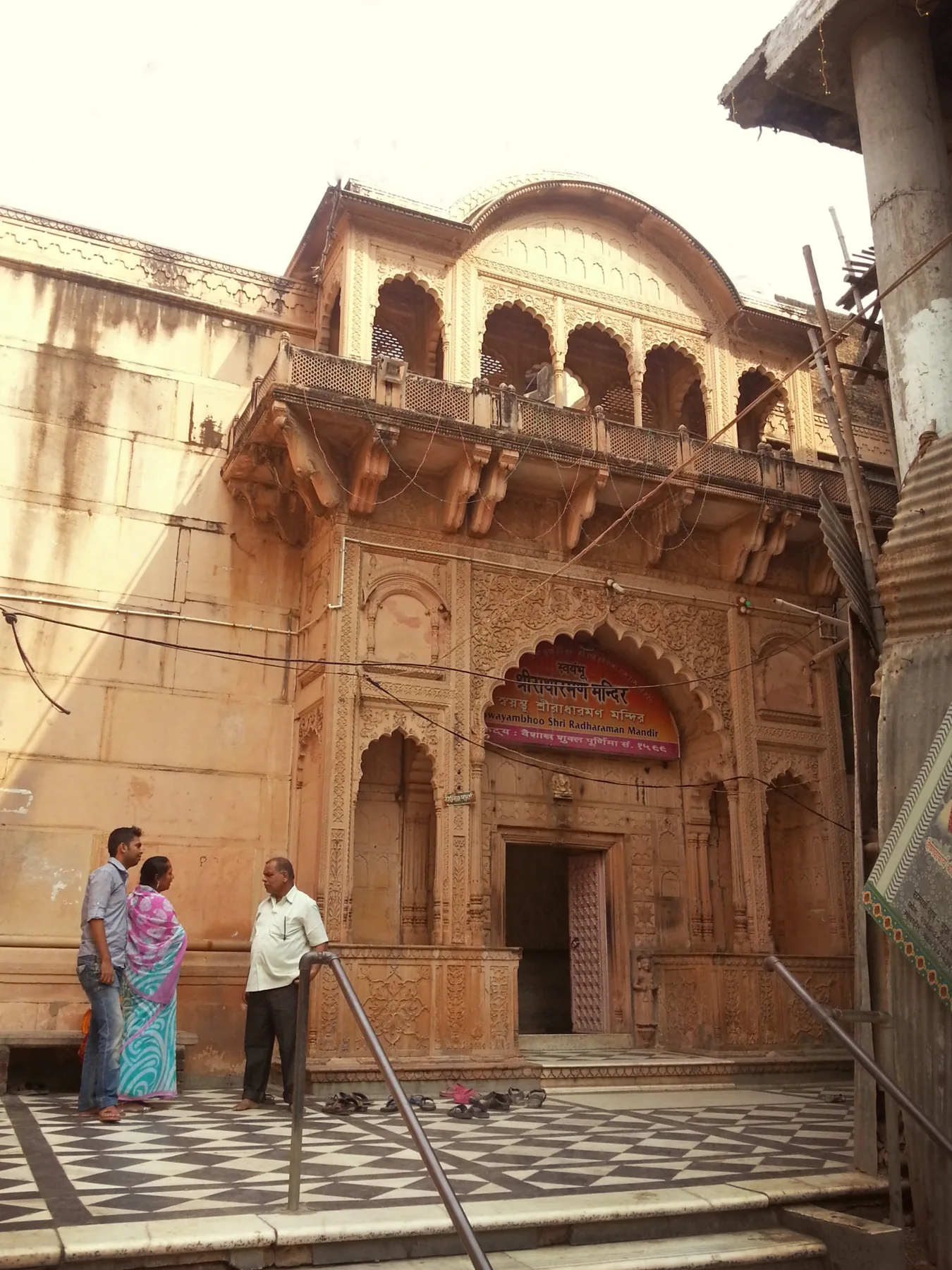
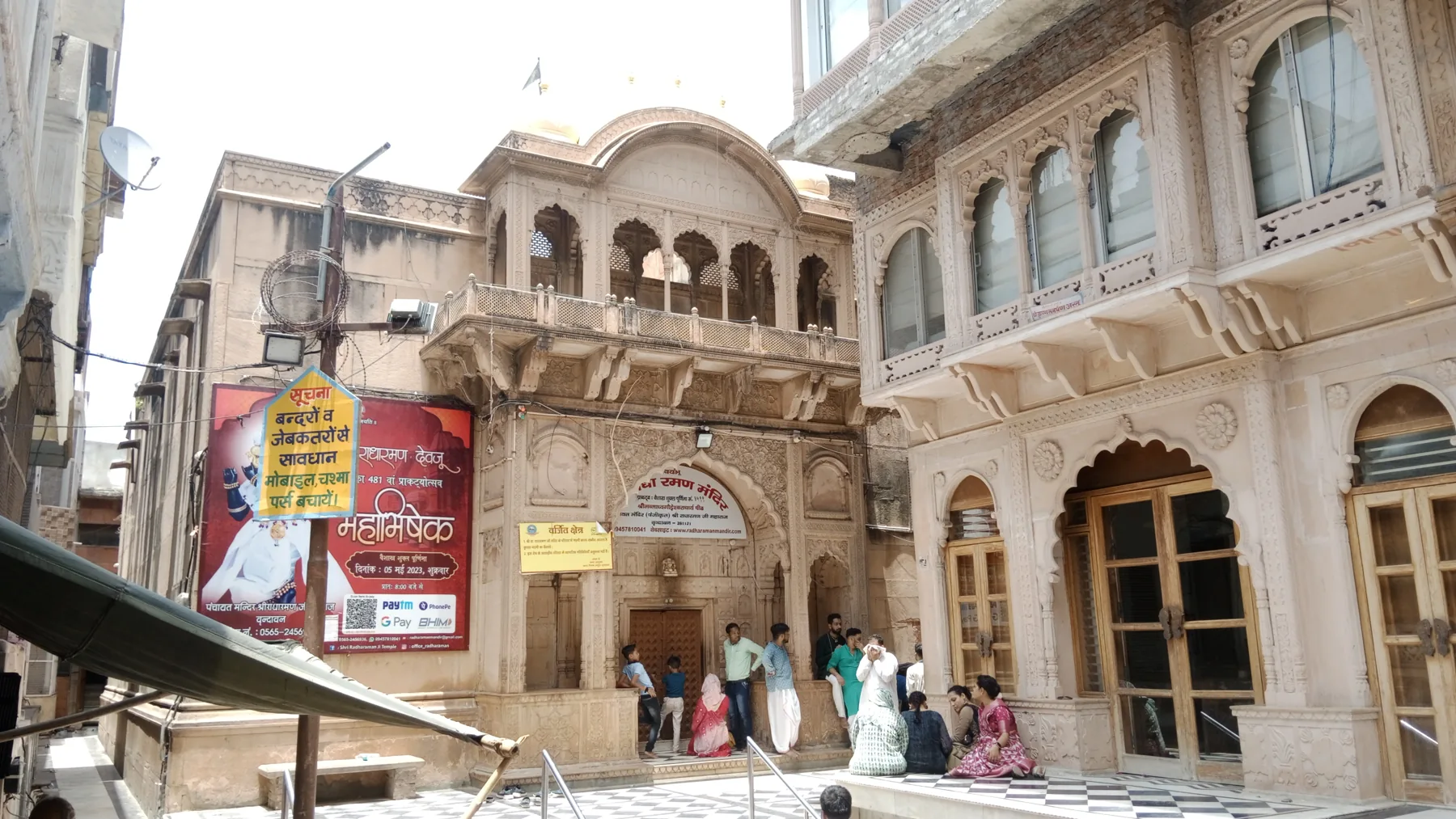
A temple grew up around the very spot where the transformation occurred , the appearance place still exists, marked and visited today, close by an offshoot of the original tree from which Gopāla Bhaṭṭa once hung his basket of śilās, and directly behind his own samādhi (memorial shrine), which lies within the temple compound.
The temple's survival is itself part of the story devotees tell. During the Mughal period, when Aurangzeb's forces moved through Vṛndāvana destroying temple after temple and forcing the removal of nearly every major Deity to the safety of Jaipur, Rādhā-ramaṇa's soldiers reportedly mistook the modest temple for an ordinary house and passed it by. As a result, Rādhā-ramaṇa is one of the very few original Deities of the Goswāmīs never to have left Vṛndāvana , the only other frequently cited exception being Vṛndā-devī. While most of Vṛndāvana's great historical Deities today reside permanently in Jaipur, Rādhā-ramaṇa has stood, without interruption, on the same ground for nearly five centuries. Temple accounts also describe a kitchen fire kept alight, without matches, since the temple's founding , a detail offered less as historical claim than as testimony to the unbroken character of the seva itself.
Concerned, as he grew older, about who would carry the worship forward after his own passing, Gopāla Bhaṭṭa turned to his young brahmacārī disciple, Gopīnātha Dāsa, and asked him to do something unusual for a celibate renunciate: to marry, and to accept lifelong hereditary service to Rādhā-ramaṇa as a household duty rather than a solitary vow. Gopīnātha agreed, took the name Dāmodara Dāsa Goswāmī, and became the founder of the priestly (gosāñjī) lineage that has served Rādhā-ramaṇa, father to son, in an unbroken chain, ever since , the same family that still conducts His worship today.
08
Standing There Still
Rādhā-ramaṇa remains, to this day, one of the most visited and most lovingly maintained Deities in Vṛndāvana , a small, dark, flute-playing form, dressed each day in fresh finery by the descendants of a man who once had nothing to dress Him with. His temple sits quietly near Nidhuvan, unassuming from the outside in a way that, tradition says, may once have saved Him. Pilgrims who make the trip still remark on the same details noticed nearly five hundred years ago: the fine, almost impossible carving of fingernails and teeth on a form no sculptor ever touched, and the small setting laid beside Him each day for a Rādhārāṇī no one can see, but everyone there insists is present all the same.
Continue with Vraja Maṇḍala Darśana
Rādhā-ramaṇa is one of the Seven Gosvāmī temples featured in the Vraja Maṇḍala Darśana route. Continue from the story into guided darśana, temple history, etiquette, and careful parikramā.
Continue with Vraja Maṇḍala DarśanaImage Credits and References
Images: Radha Raman Temple by Kridha20, Entrance Radha Raman Temple by Ekabhishek, Radha Raman Temple, Vrindavan by Barry Silver, and Sri Ranganatha Swamy Temple Srirangam via Wikimedia Commons.
Reference pages consulted for context and image selection: Shri Radharaman Temple, Uttar Pradesh Tourism, and Radha Raman Temple, Vrindavan.