01
The Theological Weight of Ṣaḍbhuja
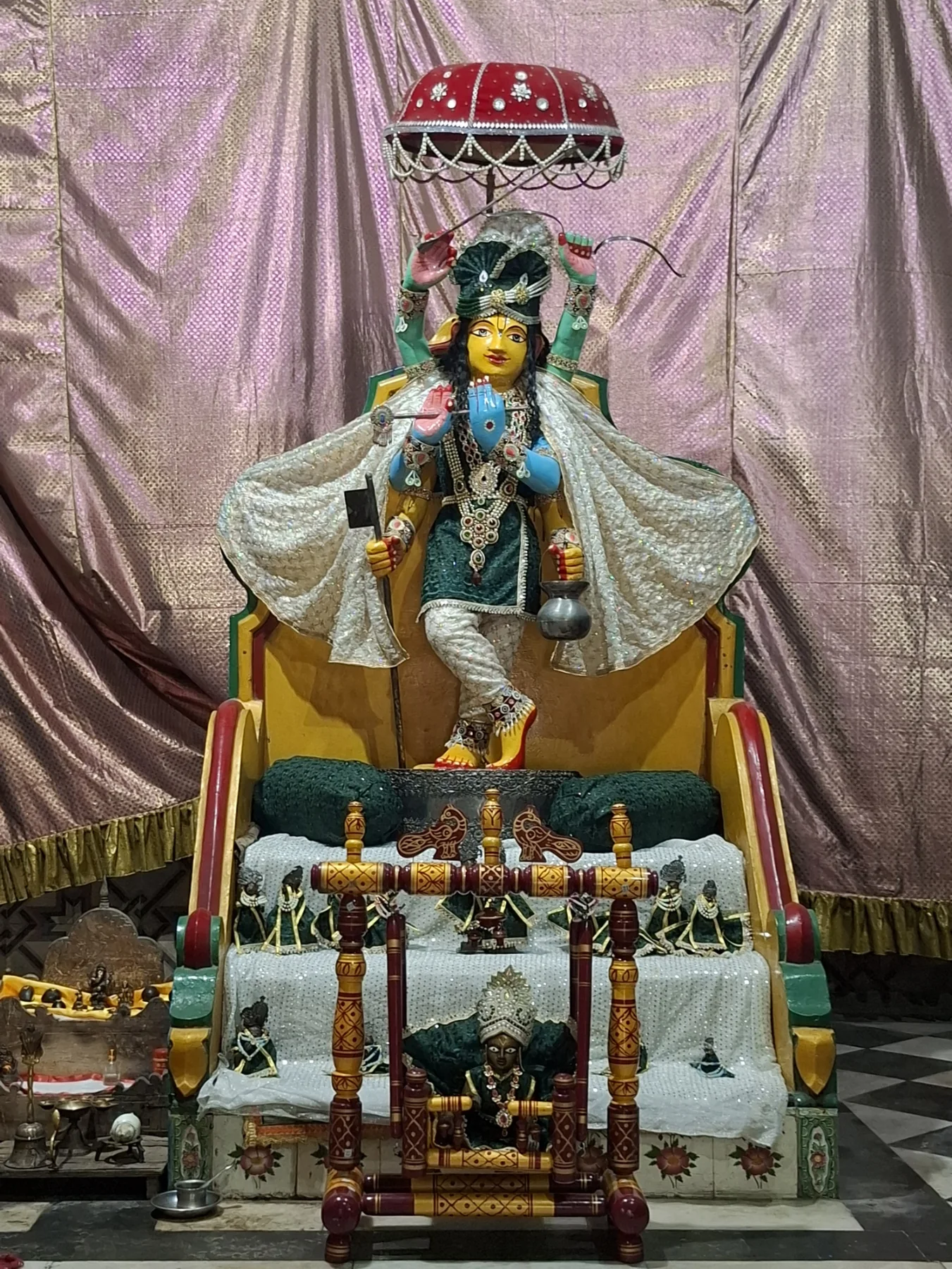
Among the many forms in which the Supreme Lord has revealed Himself to His devotees, few carry as concentrated a theological weight as the six-armed form of Śrī Caitanya Mahāprabhu, the ṣaḍbhuja-mūrti. In this form, Mahāprabhu holds, simultaneously, the bow and arrow of Śrī Rāmacandra, the flute and cowherd's staff of Śrī Kṛṣṇa, and the sannyāsa-daṇḍa and waterpot (kamaṇḍalu) of the renunciate He Himself had become. Three identities, three separate periods of divine history, three different moods of the same Absolute Truth, held together in one body, at one moment, before the eyes of a chosen few.
According to the authorized biographies of the Lord, the Śrī Caitanya-bhāgavata of Vṛndāvana dāsa Ṭhākura, the Śrī Caitanya-caritāmṛta of Kṛṣṇadāsa Kavirāja Gosvāmī, and the Śrī Caitanya-candrodaya-nāṭaka of Kavi Karṇapūra, this form was shown on three separate occasions, to three very different people, at three different points in the Lord's manifest pastimes. He showed it first to His own eternal associate, Nityānanda Prabhu, in the earliest days of Their pastimes together in Navadvīpa. He showed it next to Sārvabhauma Bhaṭṭācārya, the towering logician of Purī, who had to be won over through the most rigorous philosophical argument of the age. And He showed it a third time, years later, to Mahārāja Pratāparudra, the King of Orissa, whose devotion the Lord had spent years outwardly refusing to acknowledge. Each revelation served a different purpose. Together they tell a complete story about who Śrī Caitanya Mahāprabhu is, and about how differently the same truth can dawn on a devotee, a scholar, and a king.
What follows are the three accounts in full, told in the order they occurred, followed by the story of how this form came to be established in temple worship, both in Jagannātha Purī, where it first appeared, and later in Vraja, at the Vṛndāvana temple that stands just across from Śrī Rādhā Ramaṇa.
02
To Nityānanda Prabhu, in the House of Śrīvāsa Ṭhākura
Nityānanda Prabhu had only just arrived in Navadvīpa. He and Mahāprabhu had met for the very first time only the day before, and something had passed between Them in that meeting that the other devotees present had not yet been given eyes to see. The following day, Mahāprabhu Himself proposed that they observe Vyāsa-pūjā, the traditional worship offered to Śrīla Vyāsadeva and, through him, to the entire line of gurus, an observance kept by sannyāsīs and renunciates on the day of the full moon. Nityānanda understood at once what lay behind the proposal, though He said nothing of it. He simply replied that He wished to hold His Vyāsa-pūjā in the house of Śrīvāsa Paṇḍita.
Mahāprabhu asked Śrīvāsa to take responsibility for arranging the ceremony, and Śrīvāsa, overjoyed at being entrusted with it, agreed at once. That day Mahāprabhu led Nityānanda and the rest of the devotees to Śrīvāsa's house, and once everyone had entered, the doors were bolted shut from within. No one beyond the innermost circle of associates was to be allowed inside. Whatever was about to unfold there was not meant for public eyes. Inside, the assembled Vaiṣṇavas began the Adhivāsa-kīrtana, the preliminary chanting that precedes the main ceremony, filling the small house with the sound of the holy names in preparation for what was to come.
At a certain point, before the pūjā proper had even begun, Mahāprabhu became absorbed in the mood of Baladeva, Kṛṣṇa's elder brother, the eternal source of Ananta Śeṣa and of every incarnation of the Godhead who serves as attendant and protector to the Lord's own pastimes. Still immersed in this mood, He suddenly sat down upon the siṁhāsana, the ceremonial seat reserved for the object of worship, and asked Nityānanda to hand Him Baladeva's plough and club, the very weapons that mark Baladeva's own identity. Nityānanda placed His hand upon Mahāprabhu's hand, and in that touch, several of those present directly perceived a plough and a club appear. It was as if Mahāprabhu, before revealing anything of His own form, first drew out and confirmed before witnesses exactly who Nityānanda truly was, establishing His identity as Baladeva Himself, so that what followed could be properly understood in its full context: this was not merely a teacher showing His form to a disciple, but one eternal principle of Godhead revealing Himself to another.
The Vyāsa-pūjā then proceeded, with Nityānanda seated in the place of honour reserved for the guru-tattva, receiving worship as the ceremony required. Śrīvāsa Paṇḍita, presiding over the rite, handed Nityānanda a garland of flowers, asking Him to offer it to a painted image of Vyāsadeva that had been set up for the occasion, as is customary in this form of worship. Nityānanda took the garland in His hand, and then hesitated. He did not move to place it on the painting. Instead He glanced about the room, almost as if searching for someone, as though the actual object of the worship being conducted in Vyāsadeva's name were standing somewhere close by and had simply not yet been acknowledged. Everyone in the room watched, uncertain what He was doing. Then, to the astonishment of all present, Nityānanda turned from the painted image altogether and placed the garland on Śrī Caitanya Mahāprabhu instead.
It was the single gesture that carried the whole weight of the pastime. In the very act of performing guru-pūjā, the worship through which every disciple honours the entire disciplic succession stretching back to Vyāsadeva himself, Nityānanda had, without being told, recognised and openly declared that the living embodiment of everything that succession pointed toward, the source from which the entire chain of gurus ultimately descends, was standing in the room with them in the person of Mahāprabhu.
The instant the garland touched Mahāprabhu, He manifested His six-armed form. Six arms extended from His body, holding the conch, disc, and club of Viṣṇu together with the lotus, and in the remaining two hands, the bow of Rāma and the flute of Kṛṣṇa. This particular configuration, differing from the one later shown to Sārvabhauma, which held the sannyāsī's staff and waterpot in place of the four Vaiṣṇava emblems, was fitting for this first and most intimate of the three revelations, made to the one associate whose own identity as Baladeva placed Him at the very source from which all the incarnations of Godhead proceed. As soon as Nityānanda beheld the conch, the disc, and the other emblems shining in those six hands, He was overwhelmed entirely. He fell to the ground, unconscious, lost in the ecstasy of what He had seen.
Śrīla Bhaktisiddhānta Sarasvatī Ṭhākura, commenting on this exact scene in his edition of the Caitanya-bhāgavata, explains that by showing this form to His most intimate associate at the very outset of Their pastimes together, Mahāprabhu was establishing, in the most confidential setting possible, the principle of acintya-bhedābheda, the inconceivable, simultaneous oneness and difference between the Lord and His expansions, incarnations, energies, and devotees. Every one of these is included within Kṛṣṇa Caitanya, each retaining a distinct character even while remaining not separate from Him. Because this was the first of the three revelations, it set the pattern for what would be shown again, in different circumstances and to very different witnesses, in the years that followed.
03
To Sārvabhauma Bhaṭṭācārya, in Jagannātha Purī
By the time Mahāprabhu arrived in Purī at the age of twenty-four, having taken sannyāsa from Keśava Bhāratī in Katwa and travelled on through Śāntipura, He came upon the town by way of Āṭhāranālā, a bridge of eighteen arches that marks the traditional entrance to the holy city. From there He caught sight of the temple spire rising above the rooftops, and the sight alone was enough to carry Him into a trance of divine love. He ran toward the temple, entered, and rushed toward the Deity of Jagannātha as if to embrace Him, and as He drew close to the altar, He collapsed, unconscious, overcome by the vision.
The temple guards and attendants, finding an unknown young man in saffron cloth lying senseless before the Deity, took Him at first for a vagrant or a madman, and were on the point of driving Him out by force when Sārvabhauma Bhaṭṭācārya happened to be present and intervened. Something in the beauty of this collapsed sannyāsī, and in the ecstatic symptoms still visible on His body, told Sārvabhauma that this was no ordinary person. With the help of his own disciples and the temple guards, he had the unconscious Lord carried to his own house nearby, and, anxious for His condition, held a wisp of cotton before His nostrils to see whether He was still breathing. Seeing it stir faintly, he was relieved.
Meanwhile, Mahāprabhu's own associates, Nityānanda Prabhu, Mukunda Datta, Jagadānanda Paṇḍita, and Dāmodara Paṇḍita, arrived at the temple's Lion Gate only to learn that the Lord had already been carried off to Sārvabhauma's home. By a happy coincidence, Sārvabhauma's brother-in-law, Gopīnātha Ācārya, who was himself originally from Navadvīpa, passed by at that moment and was recognised by the Bengali devotees. Once he understood who this sannyāsī was and why He had come to Purī, Gopīnātha brought them all to his brother-in-law's house, where they found Mahāprabhu already resting under Sārvabhauma's care. Sārvabhauma offered his respects to Nityānanda, sent his own son to guide the visiting devotees to the temple for darśana of Jagannātha, and by the time they returned, having sung the holy names together, Mahāprabhu had regained consciousness. Sārvabhauma, now feeling a paternal affection toward this remarkable young sannyāsī, would not let Him go to the temple alone again; he invited Him and His companions to take their meal at his house, sent them to bathe in the sea, and on their return fed them generously with Jagannātha's mahā-prasāda.
When Sārvabhauma learned of Mahāprabhu's family background and discovered that his own father, the scholar Maheśvara Viśārada, had been a close friend of Mahāprabhu's maternal grandfather, he felt an even greater warmth toward Him, old enough himself to feel almost protective. He gently suggested that the line of sannyāsa into which the Lord had been initiated, the Bhāratī line, carried only a modest reputation among renunciate orders, and offered to arrange a more prestigious reinitiation if the Lord wished it. Gopīnātha Ācārya, hearing this, objected at once, insisting that Śrī Caitanya Mahāprabhu was the Supreme Lord Himself and stood in need of no external formality of this kind. A debate broke out between Sārvabhauma's students and Gopīnātha over the point, but Mahāprabhu Himself intervened, asking His associates not to argue further, since Sārvabhauma was only speaking out of genuine affection, being senior to Him in years.
Sārvabhauma next proposed that, since the Lord was young and strikingly handsome, He should apply Himself seriously to the study of Vedānta, which would help cultivate the deeper renunciation a sannyāsī requires. Mahāprabhu accepted the suggestion, and for seven days sat and listened as Sārvabhauma expounded Śaṅkarācārya's commentary on the Vedānta-sūtra to Him. It should be understood, for anyone unfamiliar with the term, that Sārvabhauma's authority in this rested on his mastery of a discipline called Nyāya, the classical Indian school of logic and epistemology, concerned with how valid knowledge is established and tested through perception, inference, and rigorous argument. Sārvabhauma was, by the unanimous judgment of his era, the foremost Nyāya scholar in all of Navadvīpa and Purī, a man who had transformed Navadvīpa itself into India's leading centre for the discipline. It was precisely because he represented the highest standard of formal, rigorous reasoning available in that age that what happened between him and Mahāprabhu carried the weight it did; this would not be a devotional preacher persuading a simple listener, but the Lord Himself meeting the most exacting intellect of the time on its own chosen ground.
For seven days Mahāprabhu listened without asking a single question. Eventually Sārvabhauma remarked that a serious student of Vedānta usually needs to ask questions in order to clarify difficult points, and wondered aloud whether the Lord had understood anything at all. Mahāprabhu answered simply that He had been told to listen, not to question, and that in fact He found the meaning of the sūtras entirely self-evident, as clear as the sun; it was Sārvabhauma's own commentary, He said, that seemed to obscure that clarity, the way clouds obscure the sun rather than illuminate it. Sārvabhauma, stung by the remark, entered into direct debate with Him over the nature of Brahman, arguing from scripture that the Absolute Truth is without form or qualities. Mahāprabhu, meeting him point for point, showed through both logic and citation that Brahman does possess form and quality, and then put before him the famous ātmārāma verse from the Śrīmad-Bhāgavatam, a verse describing how even self-satisfied sages who have transcended all material bondage still find themselves drawn to render loving devotional service to Hari. He asked Sārvabhauma to explain its meaning.
Sārvabhauma offered nine separate explanations of the verse, each demonstrating his formidable command of Sanskrit grammar and philosophical nuance. Mahāprabhu then offered eighteen explanations of the same verse, touching on meanings Sārvabhauma had not approached in any of his nine, in an unbroken display of scholarship that left the great logician utterly speechless. It was at this point, his own discipline having been turned back on him with a completeness he could not match, that Sārvabhauma began to understand that he was not debating an ordinary human being. He fell at the Lord's feet, begging forgiveness for the arrogance with which he had approached Him.
It was then that Mahāprabhu, in His mercy, began to reveal Himself further. He first showed Sārvabhauma a four-armed form of Nārāyaṇa, then a two-armed form of Kṛṣṇa holding a flute, and finally the six-armed form, Rāma's bow, Kṛṣṇa's flute, and the sannyāsī's staff and waterpot held together in one body, blazing, in the description preserved in the Caitanya-bhāgavata, as brilliantly as a million suns. Sārvabhauma, beholding it, fell down unconscious.
When he recovered, Sārvabhauma composed a hundred Sanskrit verses in praise of the Lord. He wrote two of them down on a palm leaf and sent them to Mahāprabhu by the hand of Jagadānanda Paṇḍita. Jagadānanda, anticipating what would happen, first copied the verses onto a doorframe before showing the leaf to the Lord, and it was fortunate that he did, for Mahāprabhu, true to His custom of avoiding personal praise, tore the palm leaf to pieces the moment He saw it. The devotees, however, had already seen the verses inscribed on the doorway, and were able to preserve them by memory. In substance, the two verses describe the Supreme Personality of Godhead as an ocean of mercy who has assumed the form of Śrī Kṛṣṇa Caitanya expressly to teach detachment, true knowledge, and devotional service to Himself, appearing in the world to revive a system of bhakti that had nearly been lost to the passage of time.
From that day, Sārvabhauma's transformation only deepened. On one occasion, not long afterward, Mahāprabhu brought him a portion of Jagannātha's mahā-prasāda while Sārvabhauma had not yet bathed or completed his morning rites, and rather than hesitate over ritual propriety, Sārvabhauma honoured the prasāda at once, quoting scripture to the effect that prasāda should never be set aside on account of timing or circumstance. Mahāprabhu, delighted to see this simple, unconditional faith taking root in so great a scholar, began to dance in ecstasy, and Sārvabhauma danced with Him. On another occasion, reciting a well-known verse from the Bhāgavatam, Sārvabhauma altered a single word of his own accord, replacing mukti-pade, "the giver of liberation," with bhakti-pade, "the giver of devotion," explaining, when questioned, that while mukti-pade was technically correct as a name for Kṛṣṇa, the word mukti customarily carried the flavour of impersonal liberation, which brought nowhere near the joy carried by the word bhakti. Word of Sārvabhauma's transformation spread through Purī's community of scholars, and one by one, many who had shared his impersonalist convictions took shelter of Mahāprabhu as well.
When the Lord finally set out on His pilgrimage through South India, it was Sārvabhauma who gave Him cloth for the journey and made one particular request before He left: that on His travels He seek out a certain government officer, Rāmānanda Rāya, on the banks of the Godāvarī, a man Sārvabhauma himself had once mocked for talking about devotional sentiment, but whom he now understood, by the Lord's own mercy, to be a Vaiṣṇava of the very highest realisation, with no equal in his understanding of the sacred rapture of Rādhā and Kṛṣṇa's love. That meeting, when it came, would be one of the most celebrated conversations in the entire Gauḍīya tradition, though it belongs to a different vision than the one under discussion here, since what Mahāprabhu revealed to Rāmānanda on the Godāvarī was the combined two-armed form of Rādhā and Kṛṣṇa together, not the six-armed form.
04
To Mahārāja Pratāparudra
Pratāparudra was king of Orissa, ruler of a realm that stretched, at the height of his power, as far south as Rājamahendrī. He governed from Cuttack, and by every account that survives of him, he was a man of considerable military strength who nonetheless carried himself with unusual humility, deeply devoted to learning and to the Vaiṣṇava tradition his family had long served. He had taken Kāśī Miśra as his spiritual master, and whenever he was in residence at Nīlācala, he would go daily to Kāśī Miśra's house after his midday meal to massage his guru's feet and inquire after the state of Jagannātha's service, a duty he never neglected regardless of the demands of state.
From the moment he first learned of Mahāprabhu's presence in Purī, Pratāparudra longed to meet Him. But Mahāprabhu, as a sannyāsī, held to a fixed and uncompromising principle: contact with kings was forbidden to a renunciate, since royal association was held to corrupt even the most sincere spiritual practice, whatever the personal qualities of the king in question. When Pratāparudra first pressed his request through Sārvabhauma Bhaṭṭācārya, Mahāprabhu's response was immediate and severe, He is recorded as saying that for a sannyāsī such as Himself, to look upon a king was no different from looking upon a woman: pure poison. Even a devotee as evidently sincere as Pratāparudra remained, in the Lord's stated position, an object to be avoided, as one avoids a venomous snake, purely on account of his royal station.
That same night, the Caitanya-bhāgavata records, Pratāparudra had a dream. He had recently watched Mahāprabhu dance in ecstatic saṅkīrtana, His body covered in dust and His mouth flecked with saliva from the intensity of His absorption, and some part of the king's mind had recoiled slightly at the sight. That night he dreamed of Lord Jagannātha, likewise covered in dust and saliva, who looked at His servant and laughed, saying that the king, being royal-born, surely found it unbecoming to touch someone in such a state. And in that same moment of the dream, Pratāparudra saw Śrī Caitanya Mahāprabhu seated beside Jagannātha on the very altar, sharing His seat. Waking from the dream, the king understood, with a certainty no argument could have given him, the true, non-different identity of the two.
Even so, years passed with the king no closer to an audience. Rāmānanda Rāya, who knew intimately how much his sovereign longed for the Lord's darśana, tried more than once to persuade Mahāprabhu on his behalf, describing the depth of the king's devotion and the freedom he had granted Rāmānanda from his official duties simply so that he might remain near the Lord. Mahāprabhu, moved by this account of loving service, once remarked that anyone who has won the devotion of His own devotee is thereby assured of being accepted by Him. Sārvabhauma, too, renewed his appeals, only to be told, this time, that if the request continued to be pressed, Mahāprabhu would simply leave Purī altogether rather than break His vow. Pratāparudra, hearing of this, was devastated. He is remembered to have said that the Lord had descended to deliver even the most fallen souls, sinners like Jagāi and Mādhāi, and yet seemed to have made a private exception of him alone. If the Lord had sworn never to see him, the king declared, then he in turn had sworn he would not go on living without that sight, for without Śrī Caitanya Mahāprabhu's mercy his life and his entire kingdom meant nothing to him.
It was Sārvabhauma who eventually devised a way around the impasse. During the Ratha-yātrā festival, after dancing with His devotees, Mahāprabhu customarily withdrew to rest in a flower garden. Sārvabhauma advised the king to approach Him there dressed as an ordinary commoner, stripped of every mark of royalty, and to recite verses from the Rāsa-pañcādhyāya of the Bhāgavatam, the account of Kṛṣṇa's love for the gopīs, reasoning that the Lord, carried away by the sentiment of those verses, would very likely embrace whoever was reciting them without pausing to ask who he was.
Before that plan could be carried out, however, Mahāprabhu returned from His long pilgrimage through South India, and Pratāparudra, unable to contain his longing any further, wrote directly to Sārvabhauma renewing his request. Sārvabhauma showed the letter to the assembled devotees, and all were struck by the depth of feeling it revealed. Nityānanda Prabhu took it upon himself to speak to the Lord, not to press the case for a meeting directly, but simply to describe the king's state of mind. He told Mahāprabhu that Pratāparudra had resolved, if he could not obtain the Lord's darśana, to renounce his kingdom entirely and become a mendicant, piercing his own ears for a yogī's earrings, since a kingdom held no value to him without Gaurahari's mercy. Mahāprabhu, hearing this, still held to His position, insisting that a sannyāsī is forbidden even to look upon a king for the sake of his own spiritual integrity, and that if He set aside this rule, His own associate Dāmodara Paṇḍita would be right to criticise Him for it. Dāmodara himself, present at the exchange, gently observed that while he had no authority to instruct the Lord, he suspected the meeting would happen regardless, since the Lord's nature was to be moved by the sincere love of His devotees even while remaining, in essence, completely independent.
Nityānanda, for His part, pointed out a further danger: those who suffer unrequited love in this way are sometimes driven to take their own lives, and asked the Lord, for the sake of saving Pratāparudra, to at least send him a piece of His own worn cloth. Mahāprabhu could not refuse this request from Nityānanda. Govinda was asked for one of the Lord's used loincloths, and it was sent to the king through Sārvabhauma. Pratāparudra received it as though it were the Lord Himself, and began to worship it with full ceremony.
Not long after, Rāmānanda Rāya, having received the king's leave to remain near Mahāprabhu in Purī, made his own appeal on Pratāparudra's behalf, describing once more the intensity of the king's devotion. Mahāprabhu, wishing to establish a clear standard of conduct for the renounced order that others might follow, explained that even the smallest blemish on a sannyāsī's character becomes as visible to the world as a stain on white cloth, or a single drop of liquor spoiling an entire jug of milk, and that however many virtues Pratāparudra possessed, the simple fact of his being a king rendered his association contaminating by that standard alone. And yet, because of His close friendship with Rāmānanda, the Lord could not entirely refuse him either. He offered a partial concession: He would agree to see the king's son, reasoning that according to the traditional maxim that a man is reborn in his own son, there is, in essence, no real difference between father and son. Pratāparudra, hearing of this, sent his son to the Lord at once. When Mahāprabhu beheld the boy, a teenager with dark skin and almond-shaped eyes, dressed in yellow cloth, He was immediately reminded of Kṛṣṇa Himself, and embraced him, entering into full ecstatic transformation. Through that embrace to his son, the king himself tasted something of the same ecstasy, and from that day the prince was counted among Mahāprabhu's own associates.
Still the direct meeting had not come. It arrived, in the end, through the king's own humility rather than through any arrangement made on his behalf. Every year at Ratha-yātrā, before Lord Jagannātha's chariot was drawn from the temple, Pratāparudra would personally take up a gold-handled broom and sweep the road before it, sprinkling the way with scented water and sandalwood, an act of menial service that the ruler of an entire kingdom performed with his own hands. When Mahāprabhu saw the crowned head of Orissa engaged in this lowly service to the Lord, His resolve softened, even as He continued, outwardly, to maintain a stern bearing before His own associates so as not to be seen relaxing the standard He had set. During that same festival, dividing His Bengali devotees into seven kīrtana parties, each of which believed in its own ecstasy that Mahāprabhu was dancing with them alone, the king watched from the protective ring his own soldiers formed around the Lord, resting his hand on the shoulder of his minister Haricandana, transported by what he witnessed.
At one point during this dancing, absorbed in the mood of Rādhā and the gopīs meeting Kṛṣṇa again at Kurukṣetra after His long absence in Dvārakā, Mahāprabhu danced with such intensity, straining as He was to draw Jagannātha's chariot, representing Kṛṣṇa's opulent life at Kurukṣetra, back toward the site of His sweeter, more intimate pastimes at Vṛndāvana, represented by the Guṇḍicā temple, that He nearly collapsed. He fell, as it happened, directly toward the spot where Pratāparudra stood, and the king caught Him in his arms before He could touch the ground. Mahāprabhu, on realising it was the king who had caught Him, immediately began to rebuke Himself aloud for having allowed a man of worldly affairs to touch His body, though this reproach, coming as it did after the Lord had already privately resolved to show the king mercy on account of his humble service, was understood by those present to be more instructive than genuinely severe, a lesson for the assembled devotees rather than a real reversal of feeling.
Later that same festival, when Jagannātha's chariot halted midway between the temple and the Guṇḍicā, as was customary, for the Lord to rest, Mahāprabhu withdrew to a flower garden near a grove of coconut trees to avoid the crowds pressing in to offer food. Pratāparudra remembered Sārvabhauma's earlier counsel. Dressed as an ordinary man, stripped of every royal mark, he approached the resting Lord and began to massage His feet, reciting, as he had been advised, verses from the gopīs' songs of separation in the Bhāgavatam, beginning with a verse celebrating how the glories of Vraja had multiplied ever since Kṛṣṇa's birth there, and how the goddess of fortune herself had taken up permanent residence in that land on His account. Mahāprabhu, delighted, urged him to continue. The king pressed on to a further verse, one describing how the nectar of Kṛṣṇa's own words gives life to those consumed by suffering, glorified by sages for washing away all sin, auspicious to hear, and distributed through the world by the most magnanimous of souls. On hearing the word for "the most magnanimous," bhūrida, repeated in that verse, Mahāprabhu was overcome with love and embraced the man kneeling before Him, repeating the word Himself in His ecstasy. Only then, though He is understood to know all things already, did the Lord ask who this was. Pratāparudra answered simply that he was the servant of His servant. Satisfied by this answer, Mahāprabhu revealed to him a magnificent divine form, the same six-armed vision He had shown, years before, to Sārvabhauma in that same city. The assembled devotees, witnessing the scene, rejoiced that the king had at last received the mercy he had waited so many years to receive.
Later, when the chariot could not be moved from that resting place to the Guṇḍicā temple, neither the strongest men in the crowd nor even the temple elephants proving equal to the task, much to Pratāparudra's visible anxiety, Mahāprabhu Himself stepped in, telling everyone to release the ropes, and went behind the chariot to push it forward with His own head. It began to move at once, with a great rumbling sound, to the amazement of the king and his entire retinue.
Pratāparudra's devotion did not end there. He continued to serve the Lord in whatever way he could for the remainder of Mahāprabhu's years in Purī, and when the Lord eventually disappeared from this world, the king's grief was so total that he collapsed and struck his head against the ground repeatedly, kept alive, according to the record left in the Bhakti-ratnākara, only through the presence and care of Rāmānanda Rāya. He could not bear to remain in Purī after that loss, and is said to have spent the rest of his days elsewhere.
05
The Establishment of the Form in Temple Worship
The two revelations that took place in Purī, to Sārvabhauma and, two years later, to Pratāparudra, left a lasting mark on the city's own sacred architecture, since both witnesses lived there and both, in their own way, ensured the form would not be forgotten. King Pratāparudra, having received the vision himself and knowing of Sārvabhauma's earlier darśana of the same form, had the six-armed image of Mahāprabhu painted on the outer face of the main temple tower at Jagannātha Purī, on the ceiling of the Naṭa Mandira, and in a chamber near the temple's southern gate. A deity of the ṣaḍbhuja form continues to be worshipped at the Jagannātha temple in Purī to this day, standing as the oldest and most direct link to these two pastimes. This is the older Purī shrine often mentioned alongside the Vṛndāvana temple, and it predates the Vṛndāvana temple by several centuries, tracing back to the king's own patronage in the years immediately following Mahāprabhu's manifest presence.
The Vṛndāvana temple standing opposite Śrī Rādhā Ramaṇa has a separate and considerably later history, though it belongs to the same devotional family that has preserved Rādhā Ramaṇa's own worship since the sixteenth century. It was established by Śrī Guṇamañjarī Dāsa Gosvāmī, more widely known as Gallu jī Mahārāja, a descendant of the line of Rādhāramaṇa Gosvāmī. His lineage traces directly back to Gopāla Bhaṭṭa Gosvāmī, one of the original six Gosvāmīs whom Mahāprabhu Himself sent to Vraja to establish the theology and worship of the Gauḍīya tradition there. Gallu jī was born in Vṛndāvana in 1827, the son of Rāmānandalu jī, himself a descendant of Rādhāramaṇa Gosvāmī Dāmodaradāsa jī. Beyond his devotional life, Gallu jī was a gifted poet, and his padas, devotional verses composed in the classical rāgas appropriate to particular moods, seasons, and moments of the day, remain sung within the Rādhāramaṇa temple tradition, contributing significantly to its literary and musical heritage. He installed the uniquely beautiful vigraha of the six-armed Mahāprabhu two years after this poetic and devotional career had already begun to flourish, in Vikram Saṁvat 1932 (corresponding to 1875 to 1876 CE), giving Vraja its own dedicated shrine to a form of the Lord whose original revelations had taken place hundreds of miles away, on the eastern coast, in the presence of a logician and a king.
06
A Closing Reflection
Taken together, the three revelations trace a deliberate arc. Nityānanda, the eternal associate who requires no persuasion, receives the fullest and most confidential vision first, in a private house with the doors barred, as the very foundation on which the other two revelations will later stand. Sārvabhauma, the greatest logician of the age, is shown the form only after his own formidable intellect has been exhausted in genuine philosophical struggle; the vision arrives as the completion of an argument, not a substitute for one. And Pratāparudra, a king whose very rank made him, by the Lord's own declared principle, someone to be avoided, receives the same vision only after years of persistent, humble, unrequited devotion, culminating in an act of menial service performed with his own hands before his own subjects. A devotee, a scholar, and a king: three completely different paths, arriving at the same six-armed truth.
Image Credits and References
Mandir photograph by Manaḥśikṣā dāsa / Prema Dhvani, taken at the Vṛndāvana Śrī Ṣaḍbhuja Mahāprabhu Mandir.
- Vṛndāvana dāsa Ṭhākura, Śrī Caitanya-bhāgavata, Madhya-khaṇḍa, Chapter 5 ("Lord Nityānanda's Vyāsa-pūjā Ceremony and His Darśana of the Lord's Six-Armed Form"); Antya-khaṇḍa, Chapter 3.
- Kṛṣṇadāsa Kavirāja Gosvāmī, Śrī Caitanya-caritāmṛta, Ādi-līlā 10.130, 17.12; Madhya-līlā, Chapters 6 and 7 (Sārvabhauma), 8 (Rāmānanda Rāya), 11 to 13 (Pratāparudra), 15.
- Kavi Karṇapūra, Śrī Caitanya-candrodaya-nāṭaka, Act II, texts 75 to 82.
- Locana Dāsa Ṭhākura, Caitanya-maṅgala, Śeṣa-khaṇḍa, Song 12, texts 113 to 115; Madhya-khaṇḍa (on the sannyāsa-daṇḍa prayer).
- Śrīla Bhaktivedānta Swami Prabhupāda, Śrī Caitanya-caritāmṛta, purports to Ādi 10.130 and 17.12; Śrīmad-Bhāgavatam 5.19.8 to 5.19.9, purport; Teachings of Lord Caitanya, Chapter 26.
- Śrīla Bhaktisiddhānta Sarasvatī Ṭhākura, commentary on Śrī Caitanya-bhāgavata, Madhya 5.105.
- Śrīla Bhakti Ballabh Tīrtha Gosvāmī Mahārāja, Śrī Caitanya: His Life and Associates, source for the extended Sārvabhauma and Pratāparudra biographical accounts (via Gaudiya History, ISKCON Desire Tree).
- Satyarāja Dāsa, "Ṣaḍ-bhuja-mūrti: Śrī Caitanya's Six-Armed Form," Back to Godhead magazine, March/April 2018 issue (chronology of the three revelations and history of the Purī temple paintings).
- Vrindavan Today (2021), on the founding of the Ṣaḍbhuja Mahāprabhu temple in Vṛndāvana by Śrī Guṇamañjarī Dāsa Gosvāmī (Gallu jī Mahārāja).
- Gauḍīya History / ISKCON Desire Tree, biographical entries on Sārvabhauma Bhaṭṭācārya and Mahārāja Pratāparudra.
- Note on sources: the Nityānanda and Sārvabhauma revelations are cross-confirmed across the Caitanya-bhāgavata, Caitanya-caritāmṛta, and Caitanya-candrodaya-nāṭaka. The Pratāparudra revelation is documented in Murāri Gupta's Śrī-kṛṣṇa-caitanya-carita-mahākāvya (4.16.14 to 4.16.20) and in Locana Dāsa's Caitanya-maṅgala, in addition to the Caitanya-caritāmṛta's extended narrative of the king's devotion in Madhya-līlā 11-13, which does not itself use the term ṣaḍbhuja for this final scene but which later tradition, as reflected in the Back to Godhead chronology above, identifies as the third and final revelation of this form, two years after the Sārvabhauma darśana.
Additional pages consulted for source-checking and visual research: Back to Godhead: Ṣaḍ-bhuja-mūrti, Vrindavan Today: Shadabhuj Mahaprabhu of Gallu ji Maharaj, Caitanya-caritāmṛta Ādi 10.130, Caitanya-caritāmṛta Madhya 13, and Teachings of Lord Caitanya, Chapter 26.
Continue Reading the Journal
Explore more Prema Dhvani essays on Vraja memory, temple history, sacred sound, and Gauḍīya practice.
Read the Journal